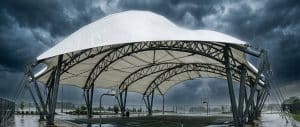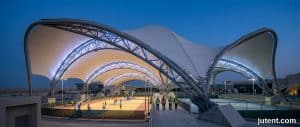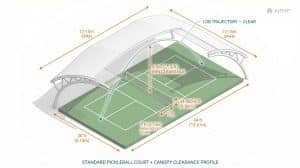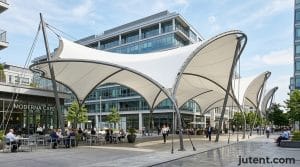

Specifying a membrane for a sports court canopy involves three decisions that most contractors get wrong the first time: UV degradation tolerance, fire rating compliance, and lifecycle cost analysis. This guide covers each one, comparing materials with the exact numbers you need to get the specification right before you go to tender. Whether you are engineering a local basketball facility or a professional tennis arena, selecting the right PVDF sports canopy or PTFE alternative dictates the structural design, the steel tonnage required, and the long-term maintenance schedule. We will break down the exact performance metrics of both materials so you can defend your specification to the client.
What is the Difference Between PVDF and PTFE Membrane?
PVDF is a flexible, coated polyester fabric ideal for most sports canopies. PTFE is a rigid, non-combustible fiberglass fabric for long-span, high-fire-rated projects.
What PVDF and PTFE Membranes Are (and What They're Not)
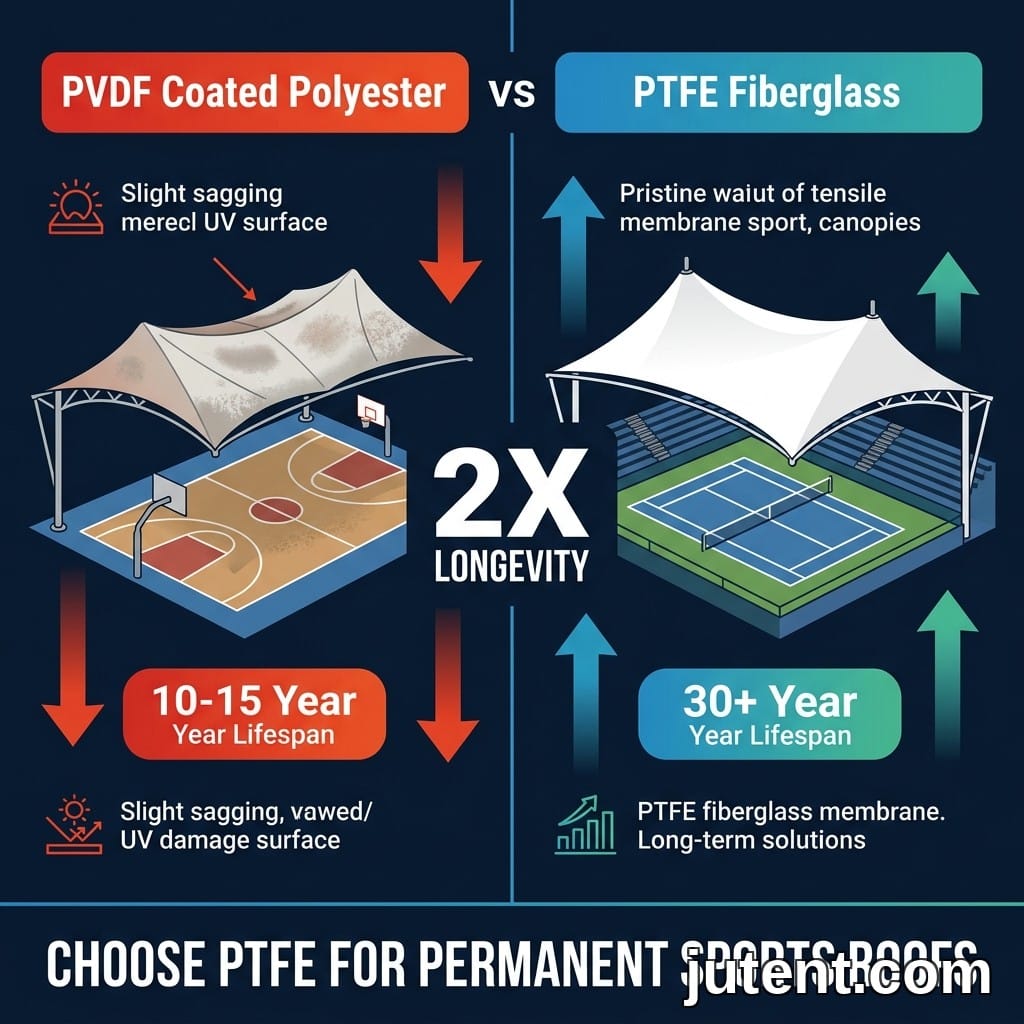
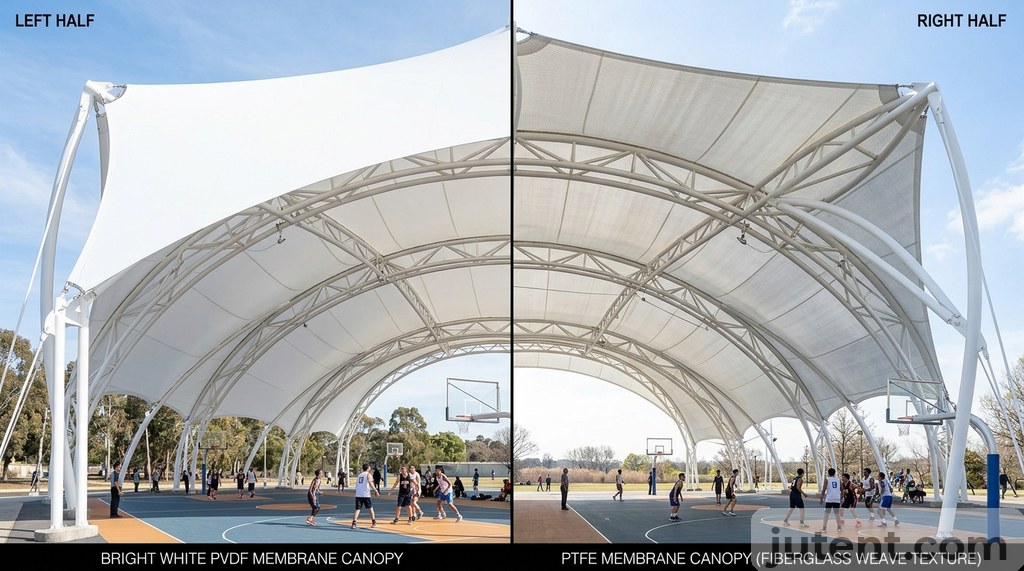
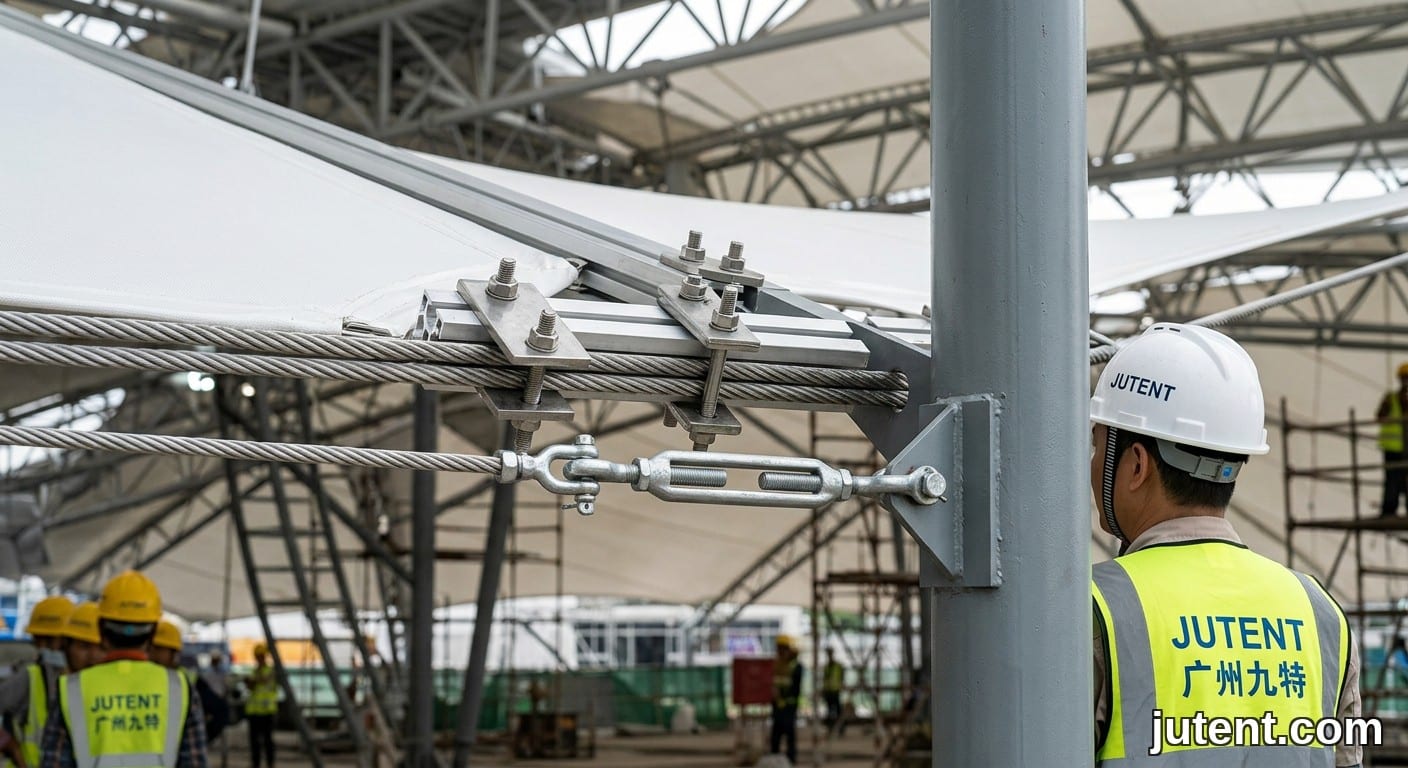
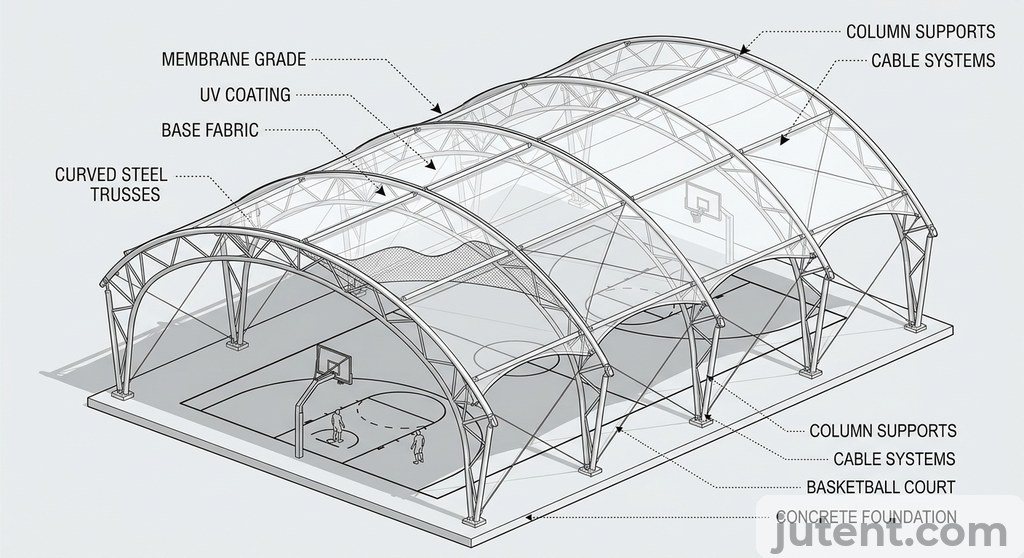
A membrane material sports court cover relies on structural fabric tensioned across a steel frame. The two dominant materials are PVDF and PTFE, but their base compositions dictate entirely different engineering approaches and installation methods.
PVDF (Polyvinylidene Fluoride) is a surface coating applied over a PVC-coated polyester base scrim. It is highly flexible, easy to weld using high-frequency equipment, and handles dynamic wind loads well without creasing. A standard specification for a Sport Court Shade is a 1050g/㎡ Type 2 or Type 3 PVDF membrane, which provides a tensile strength of approximately 4000 N/5cm. This flexibility allows it to be folded for transport and tensioned easily on site.
PTFE (Polytetrafluoroethylene), commonly known as Teflon, is coated over a woven fiberglass base. It is not a flexible polyester. The fiberglass core gives PTFE exceptional dimensional stability and an ultimate tensile strength exceeding 6000 N/5cm, but it is highly brittle during installation. It requires specialized heat-sealing irons operating at 390°C and cannot be folded without fracturing the glass fibers. Neither material is a temporary tarp; both are engineered structural fabrics designed to carry permanent pre-stress loads of 2 to 4 kN/m across large spans.
UV Resistance: How Each Membrane Performs After 10 Years Outdoors
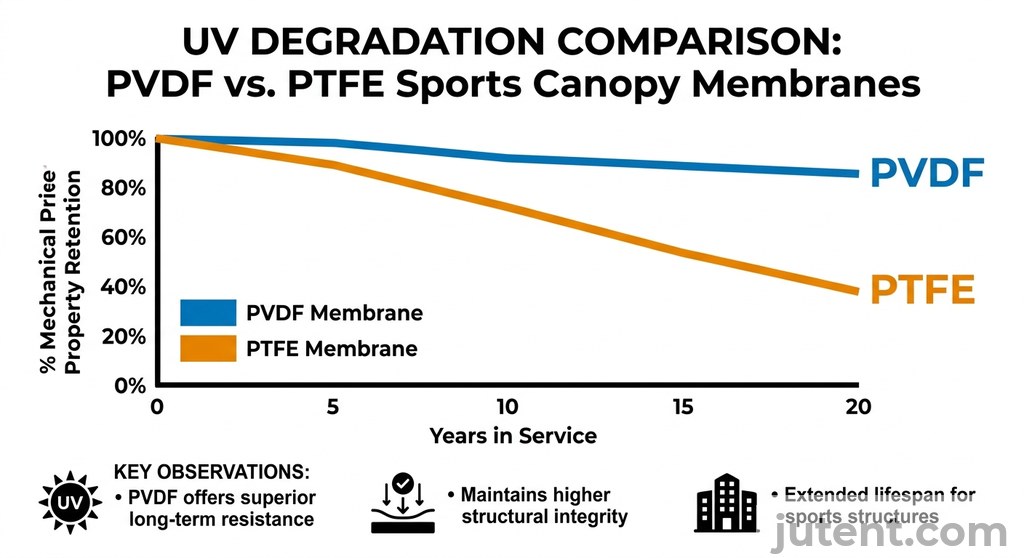
The primary failure mode for any sports court tensile membrane in tropical or desert climates is UV degradation. The performance gap between PVDF and PTFE becomes measurable at the 10-year mark.
PVDF outperforms standard PVC in high-UV environments due to its fluorocarbon surface layer, which reflects UV radiation rather than absorbing it. At UV Index 12–13, a 1050g/㎡ PVDF membrane maintains tensile strength within 10% to 15% of its original specification after 15 years. The topcoat prevents plasticizer migration, keeping the fabric flexible and preventing the base polyester from yellowing under intense solar exposure.
PTFE is entirely immune to UV degradation. Because it consists of fiberglass and Teflon, there are no plasticizers to migrate and no polymers to break down under solar radiation. A PTFE sports canopy will have the exact same tensile strength at year 20 as it did on day one. Under sunlight, PTFE bleaches white, meaning its visual light transmission (typically 10% to 15%) remains constant over decades, ensuring consistent playing conditions for athletes below.
For a detailed breakdown of chemical resistance alongside UV performance, review our detailed PVDF vs. PTFE membrane comparison guide.
Fire Rating: What Sports Court Projects Typically Require
Fire compliance dictates the membrane choice in highly regulated jurisdictions or enclosed stadium designs. A PVDF vs PTFE sports court decision often ends immediately once the local fire marshal reviews the building code and proximity to other structures.
PVDF is a combustible material that is treated with fire retardants. When exposed to flame, it melts and shrinks away from the heat source, allowing smoke to vent vertically. High-grade PVDF membranes achieve a B-s2, d0 rating under EN 13501-1, or pass NFPA 701. This is sufficient for 90% of open-air sports court canopies where smoke accumulation is not a life-safety risk and the structure is adequately separated from property lines.
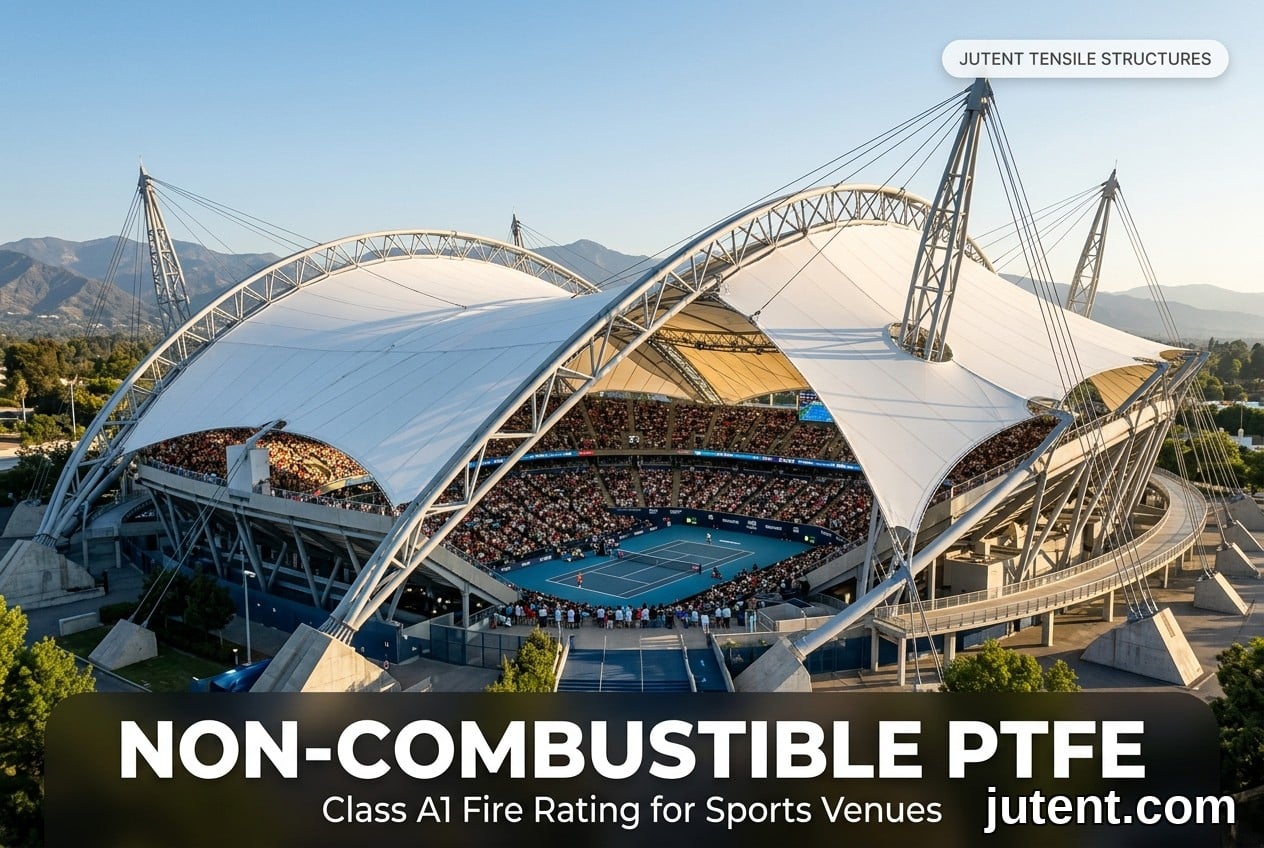
PTFE is strictly non-combustible. The fiberglass base will not burn, and the Teflon coating is non-combustible, simply decomposing at temperatures exceeding 500°C without supporting flame. PTFE achieves an A2-s1, d0 rating under EN 13501-1 and meets the stringent requirements of BS 476 Part 6 and Part 7 (Class 0). If the project is a fully enclosed arena, attached directly to a school building, or located in a dense urban zone with strict non-combustible material mandates, PTFE is the mandatory specification to ensur