

Sports Court Canopy Manufacturers: 7 Due Diligence Questions for Contractors
Not every tensile shade structure manufacturer can deliver a sports court canopy that meets local wind load standards and arrives on time. Here are the seven questions that separate reliable suppliers from the rest.
Why Manufacturer Selection Matters More Than Price for Sports Court Projects
Selecting the right sports court canopy manufacturer is a critical decision that extends far beyond the initial price quote. While cost is always a factor, prioritizing it above engineering integrity, material quality, and logistical reliability can lead to significant project delays, costly rework, and even structural failures. A poorly designed or manufactured tensile structure can compromise safety, fail to meet local building codes, and ultimately damage your reputation as a contractor.
Consider the long-term implications: a sports court shade supplier that cuts corners on steel grade or membrane quality might offer a lower upfront price, but the structure will have a shorter service life, require more frequent maintenance, and potentially fail under adverse weather conditions. For contractors and procurement managers, this translates to unforeseen expenses, warranty claims, and a loss of client trust. Verifying a manufacturer’s capabilities, adherence to international standards, and experience with similar projects is paramount. This due diligence ensures that the sports court canopy you procure is not only cost-effective but also safe, durable, and compliant with all project specifications. A reliable tensile shade structure manufacturer provides peace of mind, allowing you to focus on the overall project execution. Sport Court Shade

Question 1: Do You Have Experience with Sports Court Tensile Canopies?
The first and most fundamental question to ask any potential sports court canopy manufacturer is about their specific experience with this type of structure. While a manufacturer might have extensive experience with general tensile structures, sports court canopies often have unique requirements. These can include specific column placement to avoid interfering with play areas, considerations for lighting integration, and the need for clear spans that maximize usable space. A manufacturer with a proven track record in sports court projects will understand these nuances and can offer design solutions that are both functional and aesthetically pleasing.
Requesting a portfolio of completed sports court projects is essential. Look for examples that demonstrate a range of sizes, designs, and geographical locations, as this indicates adaptability to different environmental conditions and client needs. Inquire about the scale of their operations and their capacity to handle projects similar to yours. A manufacturer that regularly produces large-scale tensile structures for sports facilities will have established processes for design, fabrication, and quality control that smaller or less experienced suppliers may lack. Based on Jutent’s experience across 400+ projects in 30+ countries, a manufacturer’s ability to showcase relevant past work is a strong indicator of their competence and reliability as a sports court shade supplier. About

Question 2: Can You Provide Wind Load Calculations for My Location?
Structural integrity is non-negotiable for any outdoor tensile structure, especially for sports court canopies exposed to varying weather conditions. The ability to provide precise wind load calculations specific to your project’s geographical location is a critical indicator of a manufacturer’s engineering competence. Wind loads vary significantly based on factors such as local climate, terrain category, building height, and proximity to other structures. A reputable tensile shade structure manufacturer will employ structural engineers capable of performing these calculations according to international building codes (e.g., ASCE 7, Eurocode, or local equivalents).
Request detailed engineering reports that outline the design parameters, load assumptions, and structural analysis results. These documents should clearly demonstrate that the proposed structure can withstand the maximum anticipated wind speeds for your site. Be wary of manufacturers who offer generic designs without specific wind load verification, as this could lead to an under-engineered structure that poses a safety risk or fails to meet local permitting requirements. Verifying these calculations ensures that the sports court canopy will be safe, compliant, and durable throughout its service life. Typical technical values should always be written conservatively and described as subject to project design.
Question 3: What Membrane Brands Do You Use and Can You Provide Test Certificates?
The quality of the membrane material is fundamental to the performance and longevity of a sports court canopy. Not all membranes are created equal, and the choice of material directly impacts durability, UV resistance, fire rating, and aesthetic appeal. A reliable membrane structure contractor supply will offer membranes from internationally recognized brands and be able to substantiate their claims with official test certificates.
Inquire about the specific membrane brands they use, such as those known for high-performance PVDF (Polyvinylidene Fluoride) or PTFE (Polytetrafluoroethylene) coated fabrics. Request copies of test certificates for the proposed membrane, which should include data on tensile strength, tear strength, fire resistance (e.g., B1, M2 ratings), UV stability, and anti-fungal properties. These certificates, often issued by independent testing laboratories, provide objective proof of the membrane’s quality and compliance with industry standards. For instance, a standard membrane for Jutent projects is 1050 g/m² PVDF or PTFE. A PVDF membrane typically offers a 10-year warranty and 15+ years service life, while PTFE membranes come with a 15-year warranty and 25+ years service life. Insist on seeing these documents to ensure you are procuring a high-quality, durable sports court shade factory product that will perform as expected for years to come.
Question 4: What Is Your Factory Production Lead Time?
Project timelines are often tight, and delays in manufacturing can have significant ripple effects on the overall construction schedule and budget. Understanding a sports court canopy manufacturer’s factory production lead time is crucial for effective project planning and risk management. This question helps assess their operational efficiency, capacity, and ability to meet your deadlines.
Ask for a clear breakdown of the production schedule, from design finalization to fabrication and packaging. Inquire about their current production queue and how your project would fit into it. A transparent manufacturer will be able to provide realistic timelines and explain any potential factors that could influence them, such as material availability or peak season demand. It’s also wise to ask about their contingency plans for unexpected delays. For export projects, Jutent can provide design drawings, calculations, material specifications, installation manuals, and free remote guidance, subject to project scope and contract terms. A reliable tensile canopy China manufacturer will communicate openly about their lead times and work with you to establish a feasible delivery schedule, ensuring your sports court canopy arrives on time and keeps your project on track.
Question 5: How Is the Structure Packaged for Sea Freight?
For international projects, the packaging of the sports court canopy components for sea freight is a critical detail that directly impacts the condition of the materials upon arrival. Improper packaging can lead to damage during transit, resulting in costly delays, replacement parts, and potential project setbacks. This question helps assess a tensile shade structure manufacturer’s experience with export logistics and their commitment to protecting your investment.
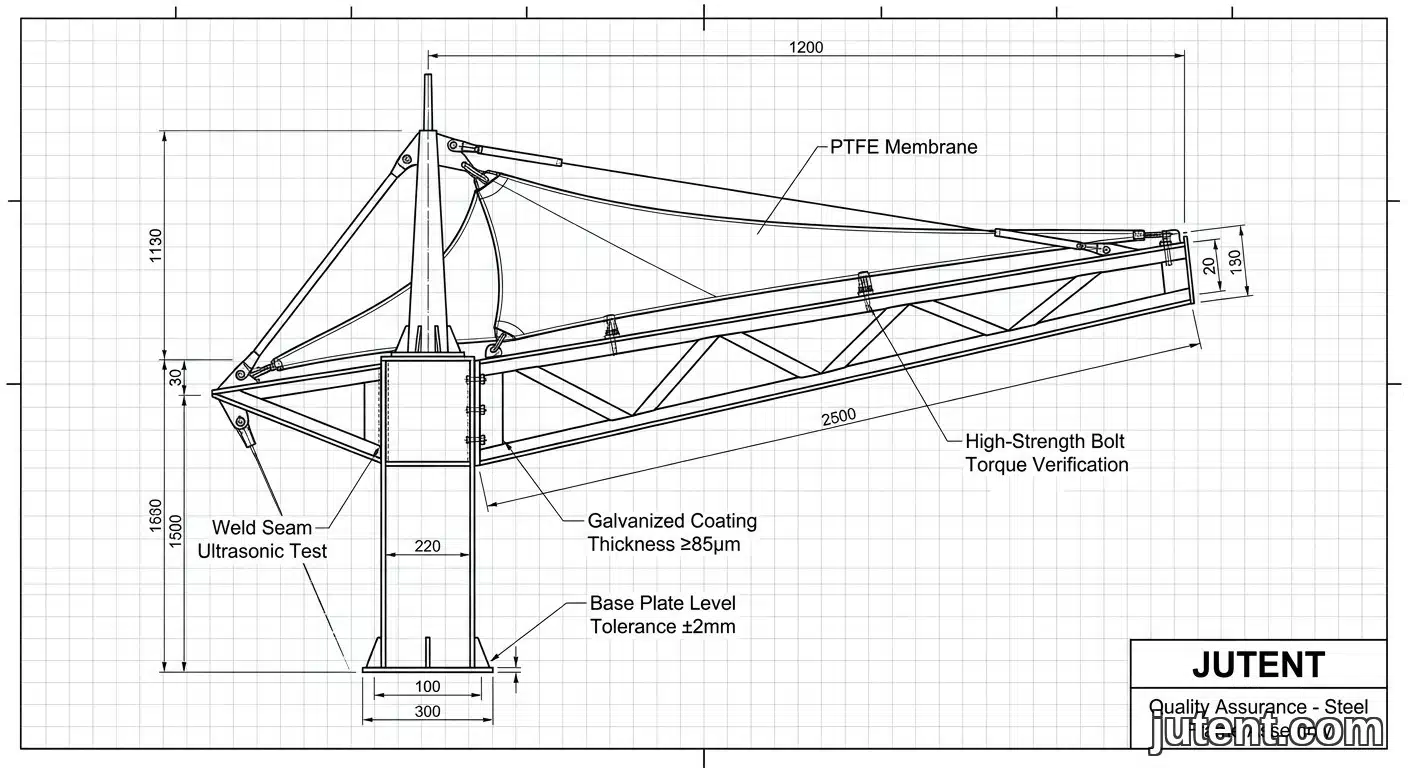
Inquire about their standard packaging methods for steel components, membranes, and accessories. Steel structures, for example, should be protected against corrosion and physical damage, often through wrapping or crating. Approved surface treatments include epoxy zinc-rich primer + acrylic topcoat, epoxy zinc-rich primer + fluorocarbon topcoat, or hot-dip galvanizing. Membranes require careful rolling and protective wrapping to prevent creasing, punctures, or contamination. Small parts and fasteners should be securely boxed and clearly labeled. Request photos or descriptions of their typical export packaging. A reputable sports court shade supplier will demonstrate a thorough understanding of international shipping requirements and employ reliable packaging techniques to ensure all components arrive at your site in pristine condition, ready for installation.
Question 6: What Installation Support Do You Provide?
The successful installation of a sports court canopy is as important as its design and fabrication. Even the highest quality structure can be compromised by incorrect installation. Therefore, understanding the level of installation support a tensile shade structure manufacturer provides is crucial for contractors. This question helps you assess their commitment to the project’s success beyond just supplying the materials.
Inquire about the types of support available. Does the manufacturer provide detailed installation manuals, engineering drawings, and assembly guides? Are these documents clear, comprehensive, and easy to follow? Many manufacturers offer free remote guidance, where their technical team can assist your on-site crew via video calls or phone. For more complex projects or if your team lacks specific experience with tensile structures, ask if on-site supervision is available as a paid service. This involves sending an experienced supervisor to your site to oversee the installation process, ensuring it adheres to design specifications and safety protocols. A reliable sports court canopy manufacturer will offer a range of support options to facilitate a smooth and efficient installation.
Question 7: Can You Provide References from Similar Projects?
Verifying a sports court canopy manufacturer’s claims and capabilities through independent references is a fundamental step in due diligence. While a manufacturer can present an impressive portfolio and detailed technical specifications, hearing directly from past clients provides invaluable insight into their reliability, communication, and project execution. This question helps you gain confidence in their ability to deliver on their promises.
Request contact information for at least two or three clients who have procured similar sports court canopies or large-scale tensile structures. When contacting these references, inquire about their overall experience with the manufacturer, including aspects such as adherence to timelines, quality of materials, responsiveness to issues, and post-delivery support. Ask specific questions about the project’s complexity, the manufacturer’s problem-solving abilities, and whether the final product met their expectations. A reputable tensile canopy China manufacturer will be transparent and willing to provide references, as they stand behind their work and client satisfaction. This step provides an objective perspective and helps you make an informed decision when selecting your sports court shade factory.
FAQ
- What is the advantage of sourcing a sports court canopy from a Chinese manufacturer?
- Chinese manufacturers typically offer 30–50% lower supply cost than local fabricators in Southeast Asia or the Middle East, with comparable quality when the right supplier is selected. The key is verifying membrane brand, steel grade, and engineering documentation. For example, Jutent uses Q235B or Q355B steel and provides ISO 9001 and SGS certifications. This cost efficiency, combined with high production capacity, makes them an attractive option for large-scale projects, provided due diligence on quality and compliance is thoroughly performed.
- How do I verify that a Chinese tensile canopy manufacturer is legitimate?
- Request factory audit photos, membrane test certificates (ISO or equivalent), and references from completed projects in your target region. Legitimate manufacturers will provide all of these without hesitation. check for certifications like ISO 9001 and SGS, which indicate adherence to international quality management standards. Insist on detailed engineering drawings and material specifications. A transparent manufacturer will readily share documentation, demonstrating their commitment to quality and compliance, and confirming their legitimacy as a reliable sports court shade supplier.
Contact Jutent with your project details and we’ll answer all seven questions with documentation within 48 hours.


