

“`html
The afternoon sun beat down on the newly installed playground, its vibrant colors inviting but its surfaces already warming to the touch. A local council project manager, surveying the scene, knew the final piece of the puzzle was crucial: shade. The budget was tight, the area substantial, and the need for durable, effective UV protection paramount. The question wasn't if to provide shade, but how. Was a series of individual playground shade sails sufficient, or did the project demand the engineered elegance and expansive coverage of a tensile membrane structure (canopy)? This common dilemma highlights the critical design factors that differentiate these two popular shade solutions, impacting everything from initial cost to long-term performance and safety.
What Playground Shade Sails Are and What They're Not
A playground shade sail is a fabric structure tensioned between multiple anchor points, typically poles or existing building facades, to create a shaded area. These sails are usually made from high-density polyethylene (HDPE) knitted fabric, which allows for air circulation, reducing heat buildup underneath. They are characterized by their often organic, free-form shapes, which can add an aesthetic appeal to a playground. The primary function of a commercial shade sail playground is to provide UV protection and reduce ambient temperature, making play areas safer and more comfortable for children. They are a cost-effective solution for covering smaller, discrete areas, offering flexibility in design and installation. [IMAGE: Playground shade sail]
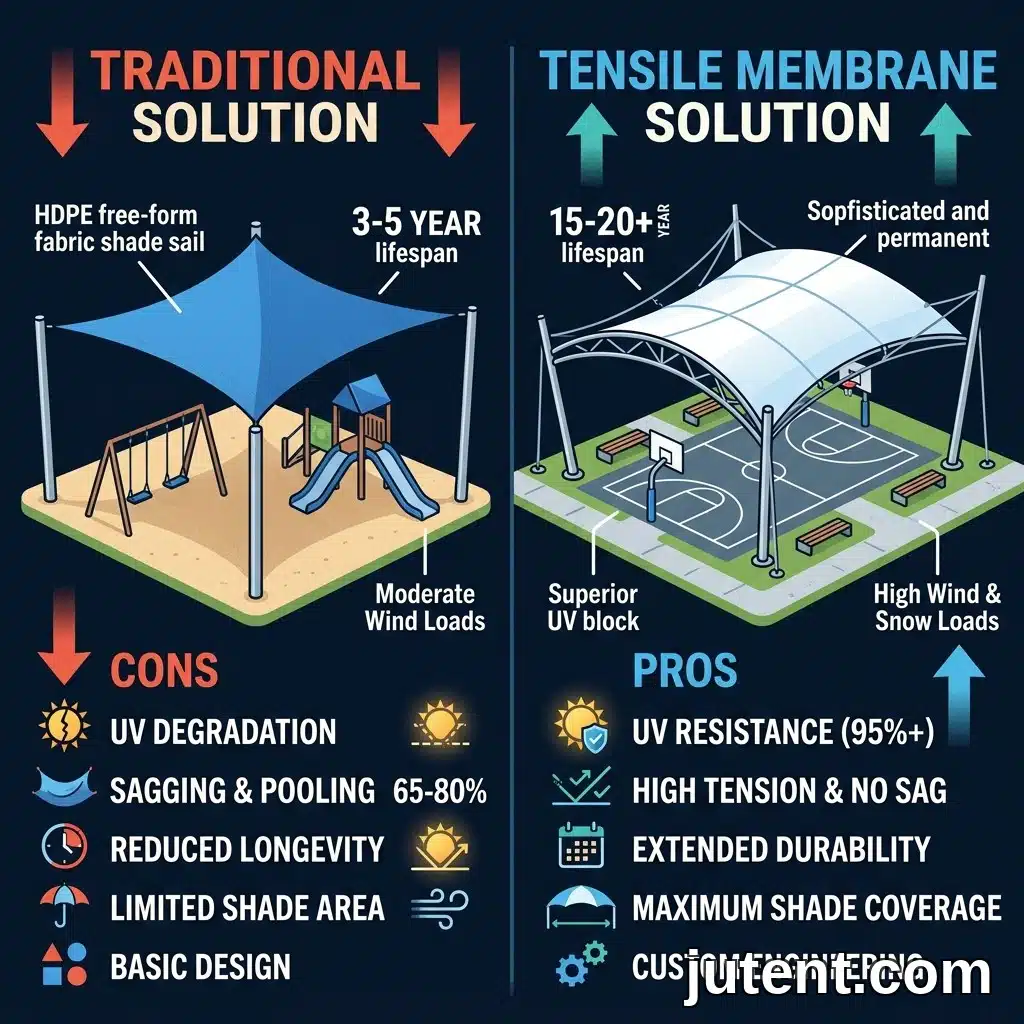
However, it's crucial to understand what a playground shade sail is not. It is not a rigid, fully enclosed structure, nor is it designed for extreme weather conditions without specific engineering. Unlike a tensile canopy, which often features a reliable steel framework and a more durable, waterproof membrane, a shade sail relies on the tension of its fabric and the strength of its anchor points. While effective for sun protection, most standard shade sails are not fully waterproof, meaning they will not provide complete shelter from rain. Their design also means they typically require removal in very high winds or during winter in areas prone to heavy snow, unless specifically engineered for such loads. For more information on playground shade options, visit our dedicated page: Compare playground shade structure options and costs
Span Limitations: How Large Can a Playground Shade Sail Be?
The size and span of a playground shade sail are inherently limited by the material properties of the shade cloth and the engineering principles governing its tensioning. While individual shade sails can be custom-fabricated, commercial playground shade sails are typically limited to a maximum panel size of approximately 6m x 6m. Exceeding this dimension with standard shade cloth significantly increases the risk of fabric stretching, sagging, and tearing under wind loads, compromising both effectiveness and safety. Larger areas often require multiple overlapping sails, which can introduce complex drainage issues and increase the number of support poles needed, potentially cluttering the play space.
Tensile canopies, by contrast, are engineered structures designed for much larger spans. Utilizing high-strength membranes like PVDF or PTFE, supported by reliable steel frameworks (Q235B, Q355B), they can cover vast areas without intermediate supports. This allows for unobstructed play zones and greater design freedom. For example, a single tensile canopy can easily span 20m x 30m or more, a feat impossible for a single playground sail shade structure. The choice between a series of smaller shade sails and a single, expansive tensile canopy hinges on the required coverage area, desired aesthetic, and long-term durability goals. Based on Jutent's experience across 400+ projects in 30+ countries, the cost-effectiveness of a tensile canopy often becomes apparent for areas exceeding 100 m², offering superior longevity and performance.

| Feature | Playground Shade Sail | Tensile Canopy (PVDF/PTFE) |
|---|---|---|
| Typical Max Span | ~6m x 6m per panel | 20m x 30m+ (single structure) |
| Fabric Material | HDPE knitted fabric | PVDF or PTFE coated architectural membrane |
| Waterproof? |
When to Choose a Shade Sail and When to Choose a Tensile Canopy
Deciding between a playground shade sail and a tensile canopy involves weighing several key factors related to project scope, budget, durability, and desired functionality.
Choose a Playground Shade Sail When:
- Budget is a primary constraint for smaller areas: Playground shade sails are generally more cost-effective for covering smaller, discrete play zones.
- Coverage area is limited: If you only need to shade a specific piece of equipment or a small seating area (typically under 36 m² per sail), individual sails are a viable option.
- Aesthetics prioritize a light, airy feel: The free-form, often colorful nature of shade sails can add a playful aesthetic.
- Seasonal removal is acceptable: In areas with extreme winter weather or very high seasonal winds, removable sails may be practical.

Choose a Tensile Canopy When:
- Coverage area exceeds 100 m²: For larger playgrounds, sports courts, or campus walkways, a single tensile canopy is more cost-effective per square meter than multiple sails.
- Year-round weather protection is required: Tensile canopies are fully waterproof and engineered for permanent installation in all seasons.
- Long-term value matters: With a service life of 15-25+ years (vs. 5-10 years for shade sails), tensile canopies offer lower total cost of ownership.
- Wind load compliance is critical: For cyclone-prone regions or areas with strict building codes, engineered tensile canopies provide documented wind load calculations.
- Unobstructed play space is needed: Single-span canopies eliminate the support poles required by multiple sails, creating safer, more open play zones.
For budget planning, tensile canopy costs typically range from $40-$90/m² EXW for PVDF, while commercial shade sails cost $20-$50/m² EXW. However, when factoring in 15+ year service life vs. 5-10 year replacement cycles, the tensile canopy often proves more economical for areas over 100 m².
Final Recommendation
For most commercial playground projects exceeding 100 m², a tensile canopy delivers better long-term value, superior weather protection, and lower maintenance costs than multiple shade sails. Request a project-specific cost comparison from Jutent to see the difference for your site.
“`


