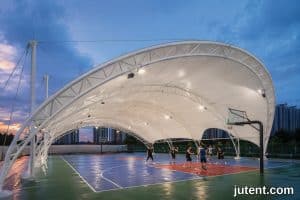
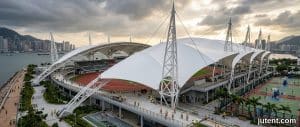
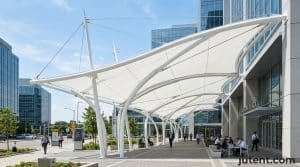
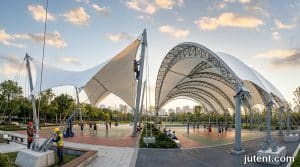
To turn a seasonal pickleball club into a year-round revenue engine, club owners must solve the dual challenge of player comfort and acoustic impact—a feat achieved only by integrating a high-performance tensile canopy designed for 150km/h wind resistance and superior sound dampening.
In our experience supplying structural kits to over 100 sports facilities globally, we have found that the difference between a thriving club and one facing neighbor complaints often comes down to the roofing material choice. This guide provides a technical deep dive into why tensile membrane structures are the gold standard for pickleball, covering acoustic performance, structural specs, and cost factors.
1. Why Pickleball Requires a Specialized Canopy Solution
Unlike tennis or basketball, pickleball's high-frequency "pop"—typically measuring between 70dB and 85dB—creates unique zoning and player experience challenges. A standard metal shed creates an "echo chamber" effect, amplifying noise and heat.
At Jutent, we engineer our pickleball court shade structures using high-tenacity polyester base fabrics with 1050g/㎡ PVDF (Polyvinylidene Fluoride) coatings. These membranes provide:
- Thermal Comfort: Reflecting up to 75% of solar radiation, keeping the court surface 5-10°C cooler than ambient temperatures.
- Glare Elimination: Soft, diffused natural light (translucency rates of 10-15%) eliminates the blinding "sun-ball" effect during overhead smashes.
- Year-Round Uptime: Protection against UV degradation and 100% waterproofing ensures play continues through mid-day heat or sudden rainstorms.
2. Acoustic Absorption: Membrane vs. Metal Roofing
A common mistake we see contractors make is recommending traditional corrugated metal roofing for pickleball facilities. In structural engineering terms, metal is a "hard" reflective surface. Tensile membranes act as a "soft" diaphragm.
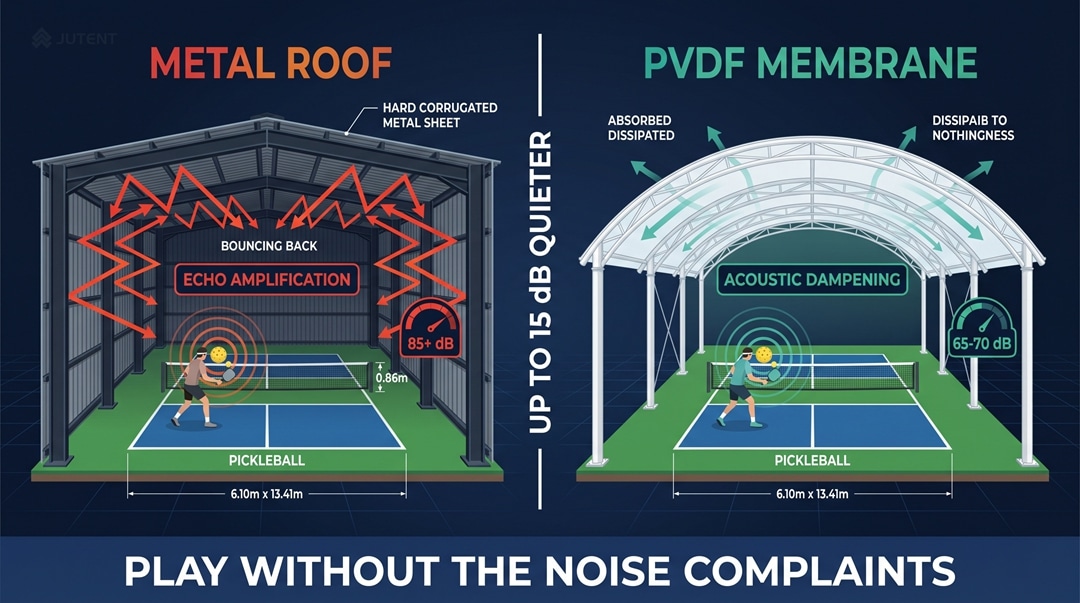
| Feature | 1050g/㎡ PVDF Membrane | Corrugated Steel (Q235) |
|---|---|---|
| Acoustic Profile | Dampens high-frequency "pop" | Amplifies and echoes noise |
| Heat Transfer | Low (Internal cooling effect) | High (Radiates heat downward) |
| Weight | Lightweight (approx. 1kg/㎡) | Heavy (requires massive footings) |
| Light Quality | Natural, shadowless diffusion | Dark (requires 100% artificial light) |
| Anti-Corrosion | C3 anti-corrosion standard | Requires frequent repainting |
3. Standard Dimensions and Clearance Requirements
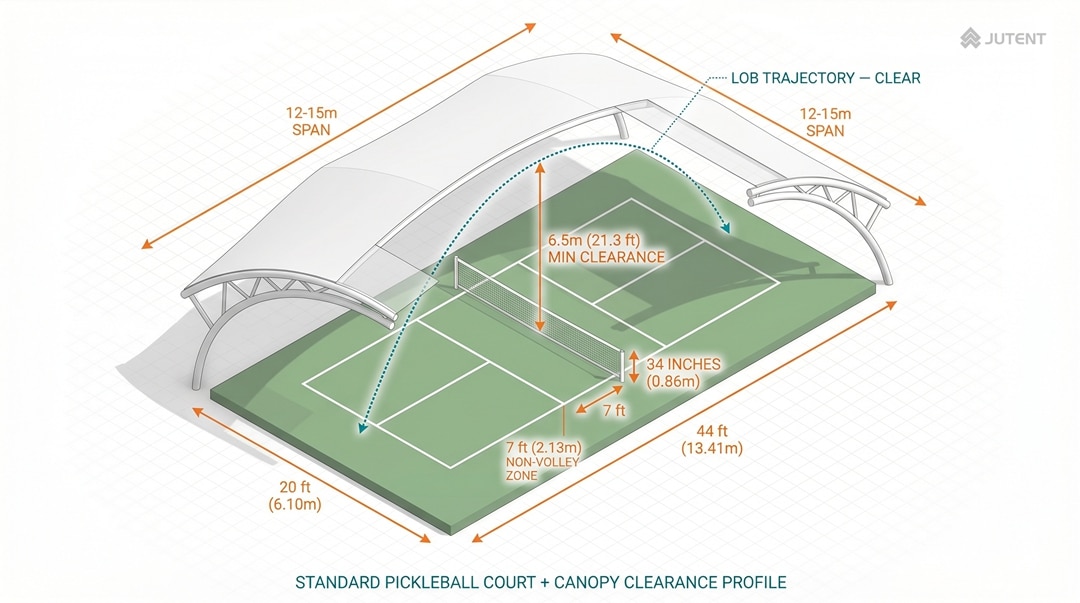
A professional-grade pickleball court canopy must respect both the 20' x 44' playing area and the required "out-of-bounds" safety zones. When reviewing structural calculations, we always ensure the center height provides a minimum of 6.5 meters (21.3 ft) of vertical clearance to accommodate high lobs without interference.
Our modular frames are typically designed in spans of 12m to 15m for single courts, or 25m+ for multi-court "super-canopies." We utilize Q355B galvanized steel for the primary arches, ensuring the structure can withstand 150km/h wind loads—critical for coastal or hurricane-prone regions.
4. Engineering for the "Supply + Support" Model
As a direct manufacturer, Jutent's role is to provide the "hardware" and the "brain" of the structure. We supply:
- Precision-Fabricated Steel: All members are pre-cut, pre-drilled, and powder-coated.
- Engineered Membrane: CNC-cut PVDF panels with high-frequency welded seams.
- The Drawing Package: Full foundation load data, assembly sequences, and bolt-torque specs.
We do not provide local crews. Instead, we empower your local general contractor or maintenance team with remote technical guidance. This modular approach significantly reduces total project costs compared to "turnkey" local firms that often outsource the manufacturing anyway.
5. Cost Range and ROI Factors
While a tensile structure requires a higher initial investment than a basic shade sail, the ROI is realized through:
- Increased Booking Fees: Premium "covered court" rates.
- Night Play: Integrated LED lighting systems are easily mounted to our steel trusses.
- Zero Maintenance: PVDF is self-cleaning; rainwater washes away dust and debris.
Estimated costs vary based on wind load requirements and soil conditions (which dictate foundation size), but supply-only kits typically range from $45 to $85 per square meter, depending on total span and material grade.
Ready to Upgrade Your Facility?
For Contractors:
For Club Owners: Tell us your court dimensions and location. We will provide a factory-direct supply quote and connect you with our technical support team to guide your local installer through the process.
Request Technical Specs & QuoteFrequently Asked Questions
How much does a pickleball court canopy cost?
The cost typically ranges from $45 to $85 per square meter for the manufactured kit (steel + membrane). Final pricing depends on your local wind/snow load requirements and whether you choose standard PVDF or premium PTFE fabric.
How long does it take to install a canopy?
For a standard two-court layout, a local crew of 4-5 people can typically complete the steel assembly and membrane tensioning in 10 to 14 days, following our provided engineering sequence.
Does the canopy help with noise complaints from neighbors?
Yes. Unlike metal roofs which reflect and amplify sound, the tensile membrane has a significantly higher Noise Reduction Coefficient (NRC). It absorbs a portion of the "pop" sound and prevents it from traveling vertically and then bouncing into the surrounding neighborhood.