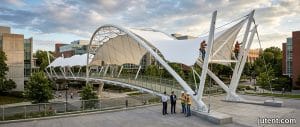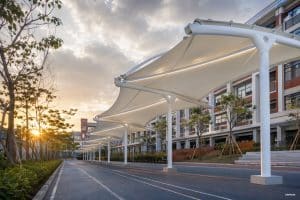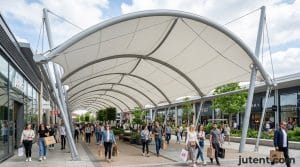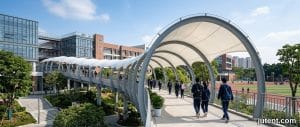

In typhoon-prone coastal regions, a school walkway canopy must survive 250 km/h winds. In tropical zones, it faces year-round UV Index 11+ exposure. In high-rainfall areas, it must channel 300mm of monthly monsoon rainfall without overwhelming the campus drainage system. A school walkway canopy Southeast Asia installation is not a standard shade sail—it is a primary structural asset that requires specific engineering for extreme weather. This guide covers what contractors in the Philippines, Malaysia, and Indonesia need to specify for school covered walkway projects to ensure structural survival, membrane longevity, and local code compliance before submitting a tender. Relying on generic architectural concepts rather than region-specific engineering data guarantees budget blowouts during the procurement phase. Understanding the exact material grades and structural loads required will protect your project margins.
Wind Load Requirements for School Walkway Canopies in Typhoon-Prone Regions
Always verify wind load calculations with a licensed structural engineer for your specific project location.
Company experience should be described through verified export experience and project support capability rather than unsupported project anecdotes.
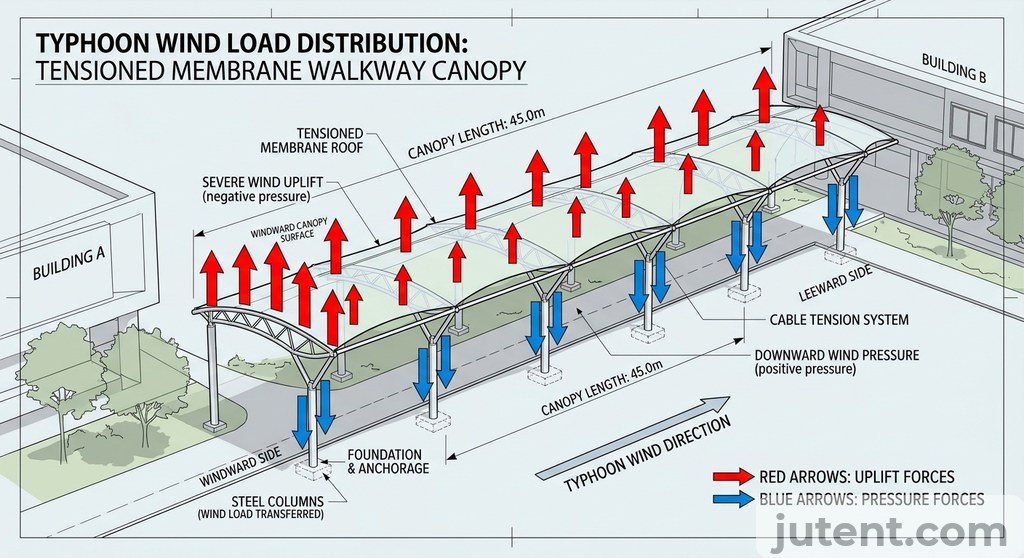
In regions with moderate typhoon risk, design wind speeds typically range from 120 km/h to 160 km/h depending on coastal proximity and local building codes. Always verify the specific wind zone for your project location., contractors safely specify 100×100×4mm SHS columns using Q355B steel grade (or equivalent S355JR) for high-wind zones, ensuring the yield strength meets the required structural load calculations. Connection detailing requires strict tolerances across all regions. Membrane tensioning hardware must utilize marine-grade 316 stainless steel turnbuckles and cables to prevent wind-induced vibration from fatiguing the connection points over the structure's lifespan.
UV Resistant Walkway Canopy: Membrane Grade Requirements for Tropical Schools
Budget planning should account for site-specific engineering requirements and local code conditions.
Budget planning should be based on structure type, clear span, wind rating, membrane grade, steel tonnage, and project scope. For an accurate EXW, FOB, CIP, or DDU quotation, the project dimensions and engineering requirements should be reviewed first.
For detailed material comparisons, refer to our School Walkway Canopy Guide for detailed material comparisons. Beyond longevity, the 1050g/㎡ PVDF-coated polyester membrane (base fabric weight 900g/㎡ with 150g/㎡ PVDF top coating) provides a UPF 50+ rating, blocking 98% of harmful UV radiation. This is a critical health and safety requirement for students transiting between classroom blocks. The membrane should also specify a high translucency variant (typically 12% to 15% light transmission) to eliminate the need for artificial lighting during daytime hours, significantly reducing the school's operational energy costs over the structure's lifespan.
Waterproof Walkway Canopy Structure: Drainage Design for High-Rainfall Schools
Southeast Asia experiences intense monsoon seasons, with peak rainfall rates frequently exceeding 100mm per hour. A school covered walkway Malaysia specification must integrate active drainage to prevent membrane ponding and protect students from heavy runoff during transit between classes.
The standard approach of allowing water to shed off the canopy edges is unacceptable in a school environment, as it creates severe slip hazards on adjacent concrete paths and erodes surrounding landscaping. Instead, the tensile membrane must be engineered with a minimum 15-degree pitch to accelerate water flow toward designated collection points.
At the lower edge of the membrane, water is directed into a continuous aluminum or steel gutter system, typically sized at 150mm width to handle high-velocity runoff. From the gutter, the water channels down through concealed PVC downpipes integrated within the primary steel columns. For a standard 3-meter wide walkway, a 100mm diameter downpipe positioned every 6 meters is sufficient to handle peak monsoon volumes without overflowing.
To prevent blockages from leaves and campus debris, the gutter system must include stainless steel leaf guards. The base of each column downpipe should connect directly to the school's subterranean stormwater network, ensuring the pedestrian surface remains completely dry and safe during heavy afternoon downpours.
School Walkway Canopy Permit Requirements for Tropical Regions
Securing building permits for a school walkway canopy Philippines project in typhoon-prone regions requires specific engineering documentation that satisfies local building authorities. The submission cannot rely on generic architectural renders; it requires wet-stamped structural calculations proving absolute compliance with the NSCP.
Company experience should be described through verified export experience and project support capability rather than unsupported project anecdotes.
In some Southeast Asian markets, approval through the local municipal council requires strict adherence to national building by-laws. The