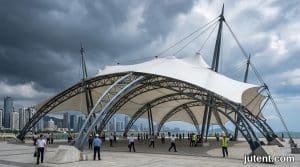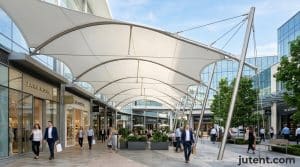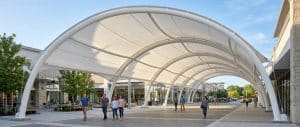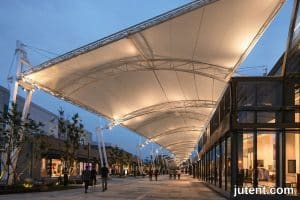

A retail walkway canopy in Southeast Asia must handle typhoon wind loads and intense tropical UV. This guide covers what contractors in the Philippines, Malaysia, and Indonesia need to specify.
Retail Walkway Canopy Southeast Asia: Engineering for Typhoon Loads & Tropical UV
Designing outdoor retail shading structures in tropical maritime climates requires strict attention to structural integrity and material durability. Commercial developers and main contractors are frequently tasked with delivering aesthetically pleasing covered corridors that seamlessly connect retail complexes, multi-level parking zones, and public transit hubs. The primary goal is to maintain uninterrupted pedestrian foot traffic regardless of inclement weather conditions. However, the severe environmental realities of the region dictate rigorous engineering standards. Successfully executing these commercial projects means integrating robust steel frameworks with high-performance tensile membranes capable of withstanding extreme weather patterns, ranging from high-velocity wind events to relentless equatorial sun exposure. Understanding localized engineering codes and detailed material specifications ensures the final structure provides optimal public safety, regulatory compliance, and long-term asset value.
Specifying a Typhoon Rated Retail Walkway Canopy for Philippines, Malaysia, and Indonesia
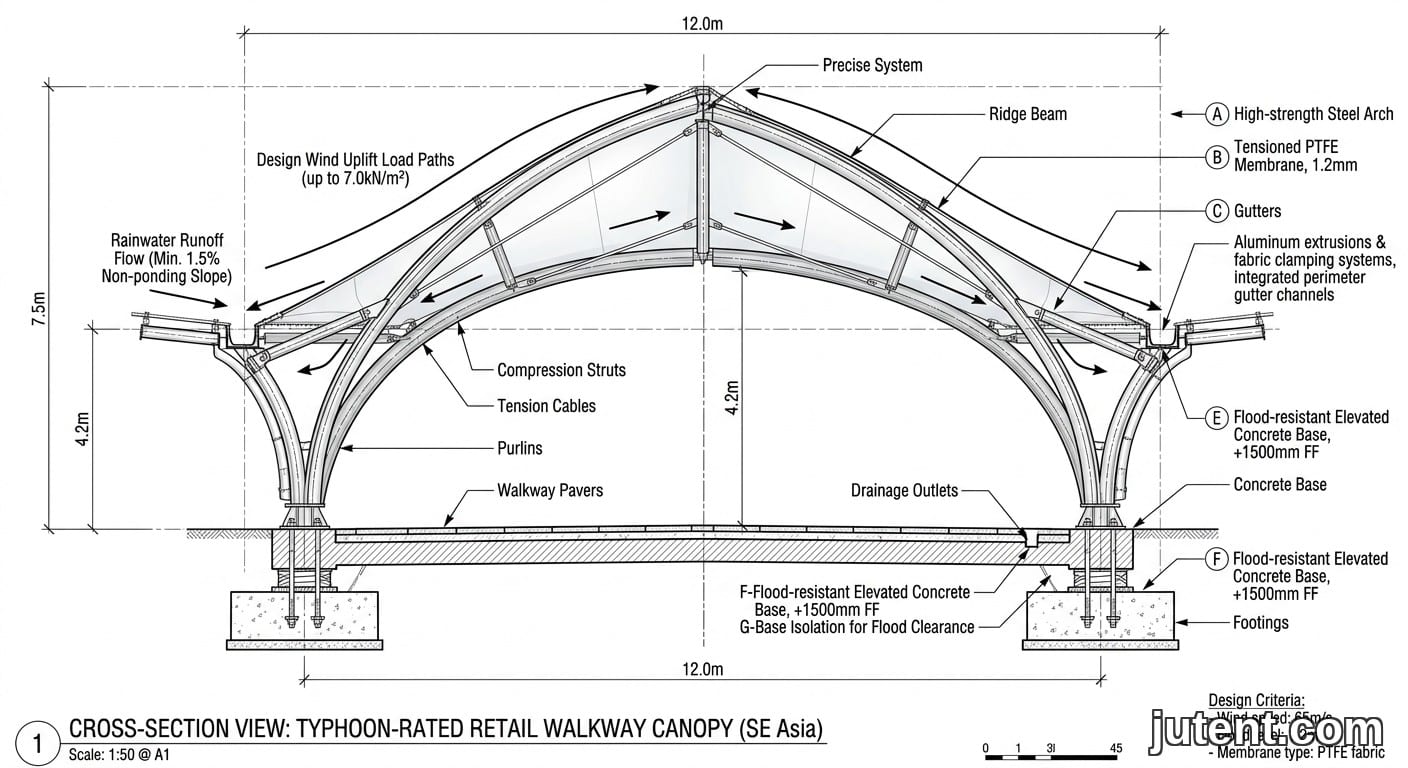
Wind loading is the single most critical structural consideration for tensile architecture operating in the Asia-Pacific region. When evaluating a retail walkway canopy Philippines specification, contractors must ensure total compliance with the National Structural Code of the Philippines (NSCP). This rigorously updated framework frequently requires designing outdoor structures to withstand basic wind speeds of 200–250 km/h, depending on the specific regional zoning and coastal proximity. The highly dynamic nature of tensile architecture means that massive uplift forces acting on the broad membrane surfaces can transfer immense stress to the supporting steel geometry. Structural engineers must utilize advanced finite element analysis to model these aerodynamic forces accurately.
Moving westward across the region, the meteorological requirements shift but remain equally demanding for project managers. A retail walkway canopy Malaysia project must adhere strictly to MS 1553 standards, typically accommodating basic wind speeds ranging from 28–40 m/s. While the peninsula is generally less prone to direct super typhoons, the seasonal monsoon gusts and sudden localized squalls necessitate highly precise structural engineering and anchoring. Similarly, executing a retail walkway canopy Indonesia installation requires careful adherence to SNI 1727 codes. Engineers must carefully calculate specific wind pressure profiles based on the complex island topography, immediate coastal exposure, and surrounding urban density.
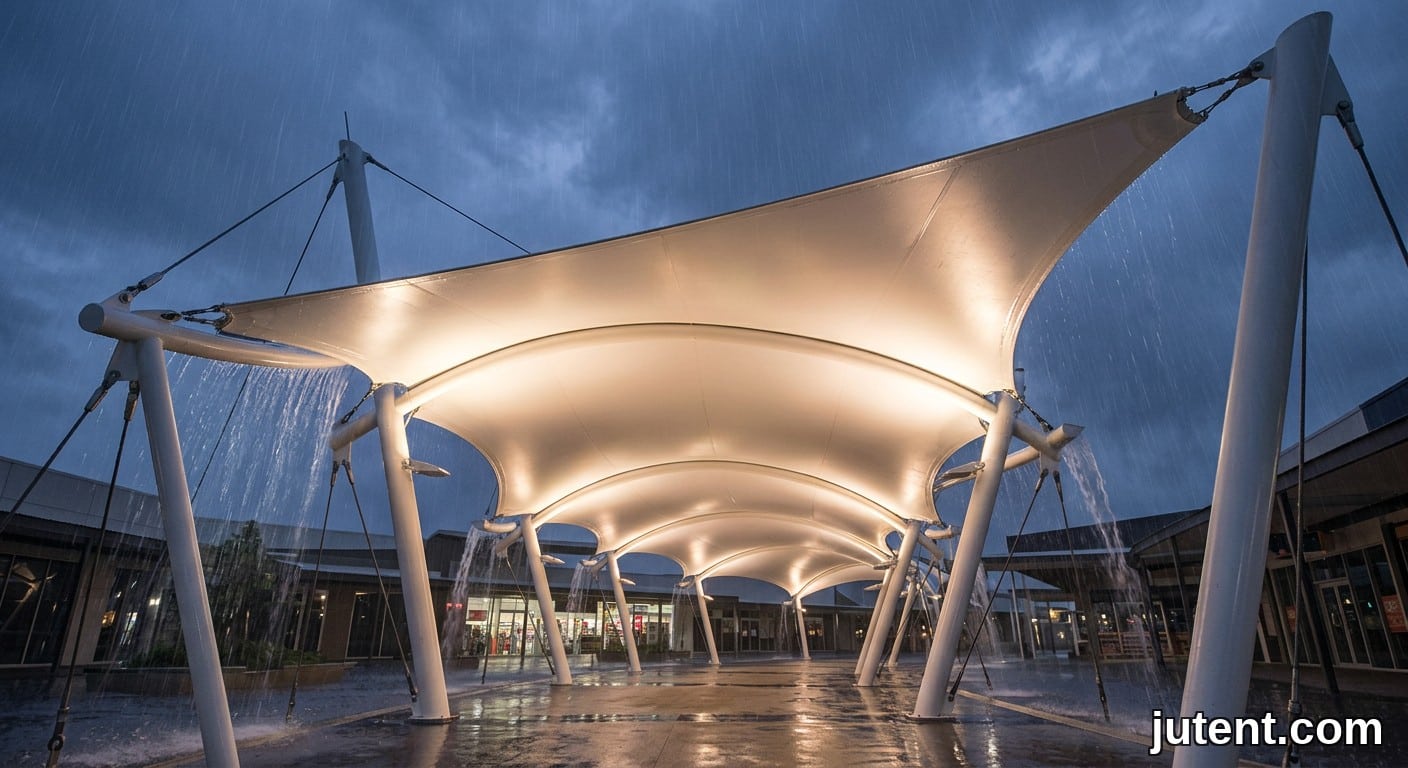
Achieving these high-capacity load tolerances requires robust structural steel grades, specifically utilizing Q235B or Q355B. The primary tubular framework must be engineered using comprehensive form-finding software to guarantee the membrane tension naturally resists excessive wind deflection without fatiguing the connection plates. For procurement teams evaluating retail walkway canopy products, it is important to note that Jutent requires a strict minimum project scope of 100 m² of membrane area. For example, a 3m wide × 34m transit corridor yields 102 m². This baseline ensures that structural efficiencies and factory engineering overheads are optimized for commercial-scale property developments.

UV Protection in Tropical Climates: Membrane Grade Requirements
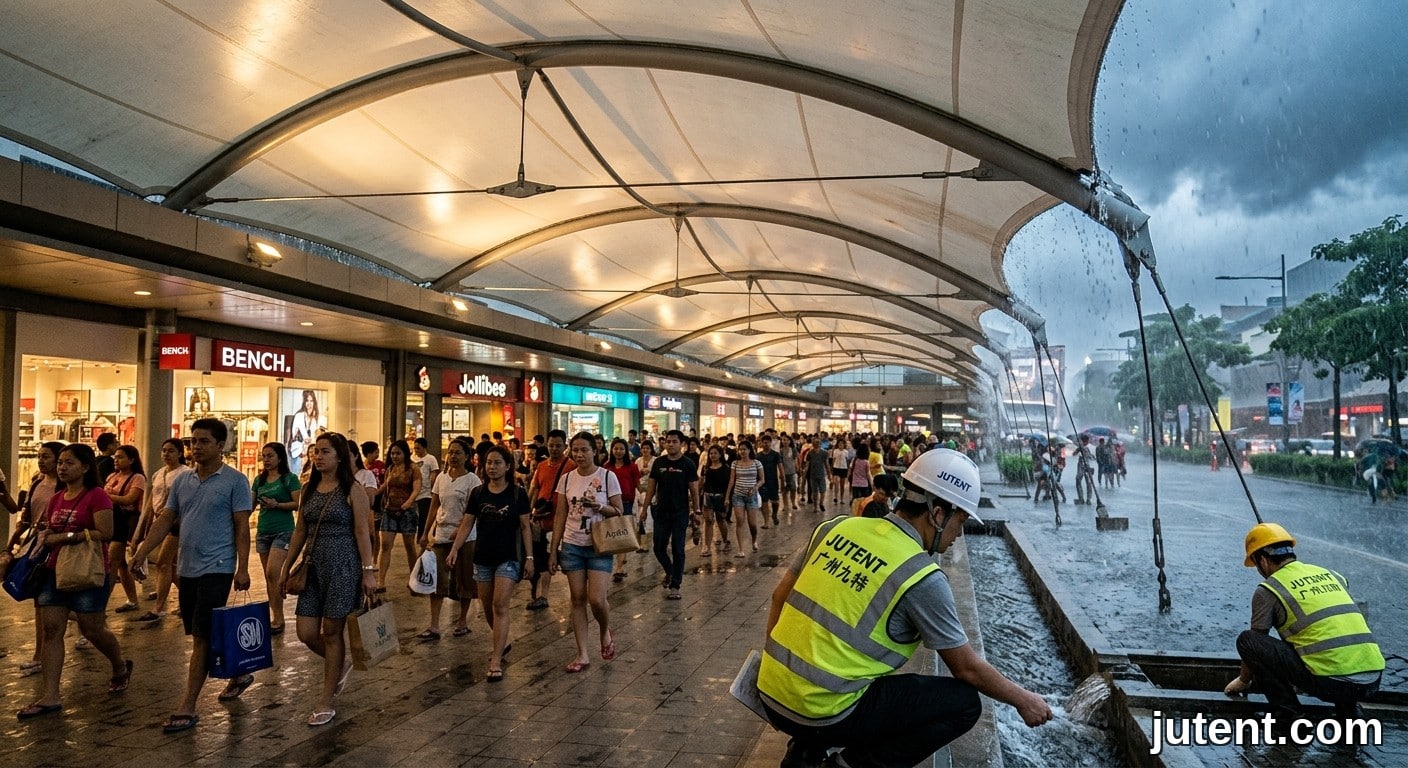
Prolonged exposure to intense ultraviolet radiation rapidly degrades inferior architectural fabrics. The harsh equatorial sun requires advanced, multi-layered coating technologies to prevent premature yellowing, plasticizer migration, and catastrophic loss of tensile strength. For standard commercial applications, a Type II PVDF-coated PVC membrane weighing 1050 g/m² is highly recommended. The Polyvinylidene Fluoride (PVDF) topcoat acts as an impenetrable sacrificial barrier, actively blocking harmful UV rays and preventing environmental dirt, exhaust particulate, and organic matter from adhering to the base PVC core. This specific self-cleaning characteristic significantly reduces ongoing maintenance costs for facility management teams. Jutent provides a standard 10-year warranty on PVDF membranes, which generally offer a functional service life of 12-15 years in severe equatorial conditions, depending on maintenance and exposure.
When the architectural brief demands maximum structural longevity or superior self-cleaning properties, Polytetrafluoroethylene (PTFE) coated fiberglass serves as the optimal engineering upgrade. PTFE is uniquely chemically inert and completely immune to structural UV degradation over time. While the initial capital expenditure for this advanced fabric is higher, PTFE carries a 20-year warranty and a proven service life extending well beyond 25 years in the field. Sourcing raw materials from established international manufacturers guarantees consistent protective coating thickness and reliable biaxial load resistance across the entire fabric batch. By selecting the mathematically correct membrane grade, contractors ensure the retail walkway retains its visual appeal and structural integrity over decades of continuous tropical sun exposure.