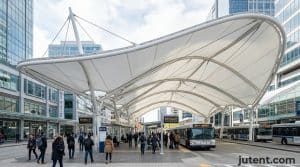

For contractors in Nigeria, Kenya, and South Africa, sourcing a warehouse tensile canopy locally often means limited options and high prices. The local market for specialized tensile structures can be underdeveloped, leading to higher costs due to limited competition, smaller production scales, and less access to advanced manufacturing techniques. This often results in longer lead times and structures that may not meet international standards for durability or design flexibility. However, importing from China offers a viable alternative, providing access to a wider range of high-quality materials, competitive pricing, and established manufacturing expertise. This article outlines how importing a warehouse tensile canopy from China works in practice, addressing key considerations for African contractors looking to optimize their supply chain and project outcomes.
Why African Contractors Source Warehouse Tensile Canopy from China
The decision to import a warehouse tensile canopy to Africa, particularly to countries like Nigeria, Kenya, and South Africa, is driven by several compelling factors. Primarily, the cost-effectiveness of Chinese manufacturing allows for significantly more competitive pricing compared to local fabrication, even when factoring in shipping and import duties. This is due to economies of scale, efficient production processes, and a mature supply chain for materials like high-grade steel and PVDF/PTFE membranes. Beyond cost, Chinese manufacturers offer a broader spectrum of design options and material specifications, catering to diverse project requirements from simple storage solutions to complex industrial facilities. Quality assurance is another critical aspect; reputable Chinese manufacturers, like Jutent, adhere to international standards (e.g., ISO 9001, SGS certified), ensuring the structural integrity and longevity of the canopy. For export projects, Jutent can provide design drawings, calculations, material specifications, installation manuals, and free remote guidance, subject to project scope and contract terms. This thorough support mitigates risks associated with remote procurement. The ability to access advanced engineering and materials, such as 1050 g/m² PVDF or PTFE membranes and Q235B/Q355B steel, ensures that the imported structures are built to withstand the specific environmental challenges of the African continent, from intense solar radiation to heavy rainfall. This strategic sourcing approach empowers African contractors to deliver superior projects while managing budgets effectively.
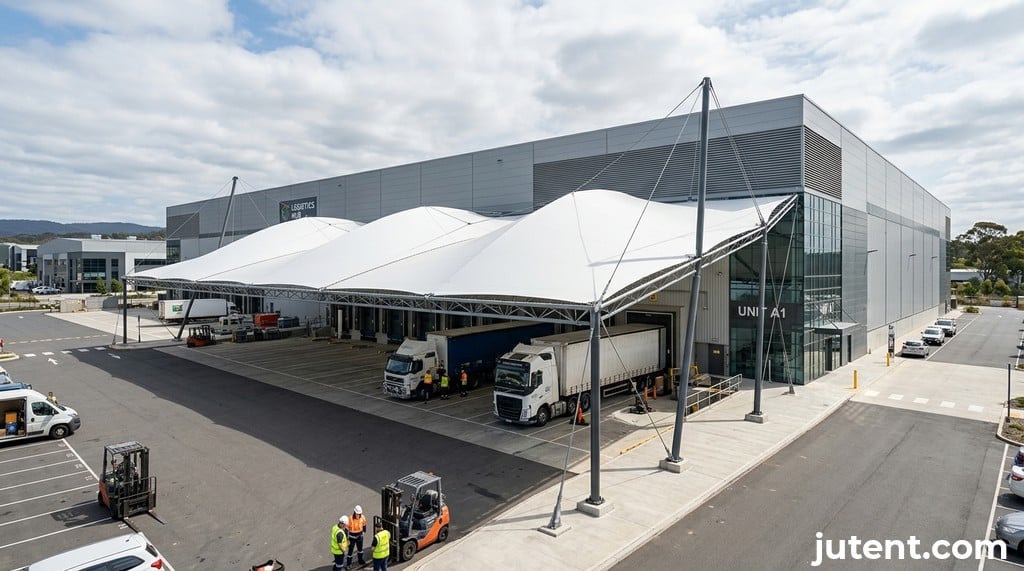
Warehousing
What to Specify When Importing: Membrane Grade, Steel, and Documentation
When importing a warehouse tensile canopy to Africa, precise specification is paramount to ensure the structure meets local conditions and project requirements. The membrane grade is a primary consideration. For most African climates, a 1050 g/m² PVDF membrane offers an excellent balance of durability, UV resistance, and cost-effectiveness, typically providing a 10-year warranty and 15+ years service life. For projects demanding extreme longevity or in particularly harsh environments, a PTFE membrane, with its 15-year warranty and 25+ years service life, is a superior choice, though at a higher price point (add ~$20/m² to PVDF range).
Steel specifications are equally crucial. Jutent primarily uses Q235B and Q355B steel grades, which are reliable and suitable for large-span structures. Surface treatment is vital for corrosion protection in humid or coastal African regions. Approved treatments include epoxy zinc-rich primer + acrylic topcoat, epoxy zinc-rich primer + fluorocarbon topcoat, or hot-dip galvanizing. Fasteners should be SS304 as standard, with SS316 available as an optional upgrade for enhanced corrosion resistance.
Comprehensive documentation is essential for smooth customs clearance and project execution. This includes detailed design drawings, structural calculations, material certifications, and installation manuals. Based on Jutent’s experience across 400+ projects in 30+ countries, providing a complete set of these documents upfront significantly streamlines the import process. Contractors should also request a packing list and commercial invoice that clearly detail the contents and value, aligning with the HS codes provided by the manufacturer to facilitate accurate duty assessment.
Warehouse Tensile Canopy Guide
Shipping to African Ports: How Structures Are Packed
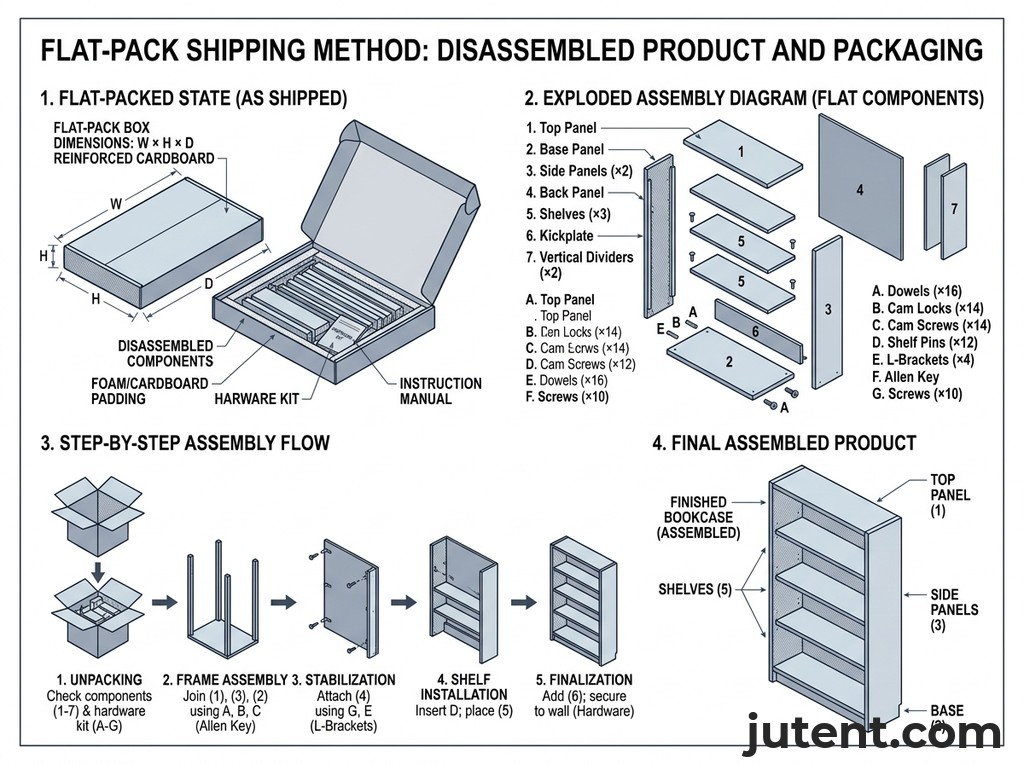
The logistics of shipping a warehouse tensile canopy from China to African ports such as Durban, Mombasa, Lagos, or Tema are meticulously planned to ensure cost-efficiency and structural integrity upon arrival. Tensile structures are designed for modularity, allowing for efficient packing and transportation. The steel framework components are typically flat-packed, maximizing container space. Large beams and columns are often bundled, while smaller connection plates, cables, and fasteners are securely boxed. The tensile membrane itself is carefully folded or rolled and protected in durable packaging to prevent damage during transit.
A standard 20ft shipping container can typically accommodate a 150–300m² tensile structure, depending on its design complexity and steel weight. For larger projects, multiple 20ft or 40ft containers are utilized. The packing strategy prioritizes minimizing volumetric weight and ensuring that all components are accounted for and easily identifiable upon unloading. Each package is clearly labeled with its contents and corresponding part numbers, which align with the provided installation manuals. This systematic approach simplifies inventory checks at the destination port and streamlines the subsequent on-site assembly. Manufacturers like Jutent work with experienced freight forwarders to manage the complexities of international shipping, including customs declarations and port handling, providing contractors with a clear shipping schedule and tracking information. This ensures that the components arrive safely and in good condition, ready for installation.
Cost Comparison: Import vs Local Fabrication in Key African Markets
For contractors in key African markets like Nigeria, Kenya, and South Africa, the cost comparison between importing a warehouse tensile canopy from China and local fabrication often reveals significant advantages for the former. While local fabrication offers immediate accessibility and supports local economies, it frequently comes with higher material costs, limited access to specialized machinery, and smaller production scales, leading to higher per-unit prices.
Importing from China, despite the added costs of shipping and import duties, typically results in a more competitive overall project cost. For a standard PVDF membrane, simple form tensile structure, the EXW (Ex Works) price from China can range from $40–$70/m². For more complex forms, this might be $60–$90/m². PTFE membrane structures would add approximately $20/m² to these ranges. These figures are for projects with a minimum scope of 100 m².
Let’s consider a hypothetical 500m² warehouse tensile canopy project in South Africa.
| Cost Factor | Local Fabrication (Estimate) | Import from China (Estimate) |
|---|---|---|
| Structure Cost (EXW) | $70–$120/m² | $40–$70/m² |
| Shipping (per m²) | N/A | $5–$15/m² (Durban) |
| Import Duties (per m²) | N/A | $3–$10/m² (varies) |
| Local Transport (per m²) | $2–$5/m² | $2–$5/m² |
| Total Estimated Cost (per m²) | $72–$125/m² | $50–$100/m² |
Note: These are illustrative estimates. Actual costs depend on design complexity, material choices, current shipping rates, and specific country import tariffs.
As the table illustrates, even with shipping and duties, the imported option often presents a lower total cost per square meter. the imported structure benefits from the manufacturer’s established quality control, advanced engineering, and reliable material warranties (e.g., 10-year PVDF membrane warranty, 15-year PTFE membrane warranty, 1-year overall project warranty), which may not be consistently available from local fabricators. This cost-effectiveness, combined with superior quality and design flexibility, makes importing a strategic choice for many African contractors.
FAQ
- Q: How are warehouse tensile canopy structures shipped to Africa from China?
- A: Warehouse tensile canopy structures are meticulously prepared for international shipping to African ports. The steel components, including columns, beams, and connection plates, are typically flat-packed and bundled to optimize space within shipping containers. The tensile membrane, whether PVDF or PTFE, is carefully folded or rolled and securely protected in reliable packaging to prevent any damage during transit. A standard 20ft shipping container can typically carry a 150–300m² structure, depending on its specific design and material weight. For larger projects, multiple containers are used, with each package clearly labeled to facilitate efficient unloading and inventory management at the destination port.
- Q: What import duties apply to warehouse tensile canopy structures in African countries?
- A: Import duties for warehouse tensile canopy structures vary significantly by country across Africa. Each nation has its own tariff schedule, which can be influenced by trade agreements, local manufacturing policies, and the specific classification of the imported goods. Jutent provides thorough HS (Harmonized System) code documentation for all components of the tensile structure. This precise classification is crucial as it helps customs officials accurately assess the applicable duties and taxes, and can assist contractors in minimizing duty exposure by ensuring correct categorization and avoiding potential penalties or delays. Contractors should consult with a local customs broker for the most accurate and up-to-date duty rates for their specific project location.
Tell us your project location in Africa and we’ll provide a cost comparison and logistics plan.