
When considering a new public space development or renovation, the integration of shade structures is often a critical early decision. For developers and contractors aiming to enhance user comfort, extend usability, and add architectural distinction, understanding the nuances of various shade solutions is paramount. This guide focuses on what is a park tensile shade structure, providing a foundational understanding of their design, function, and application. We'll explain how these structures work, what they typically cost, and key specifications to consider, helping you make informed choices for your next project.
What a Park Tensile Shade Structure Is and What It Isn't
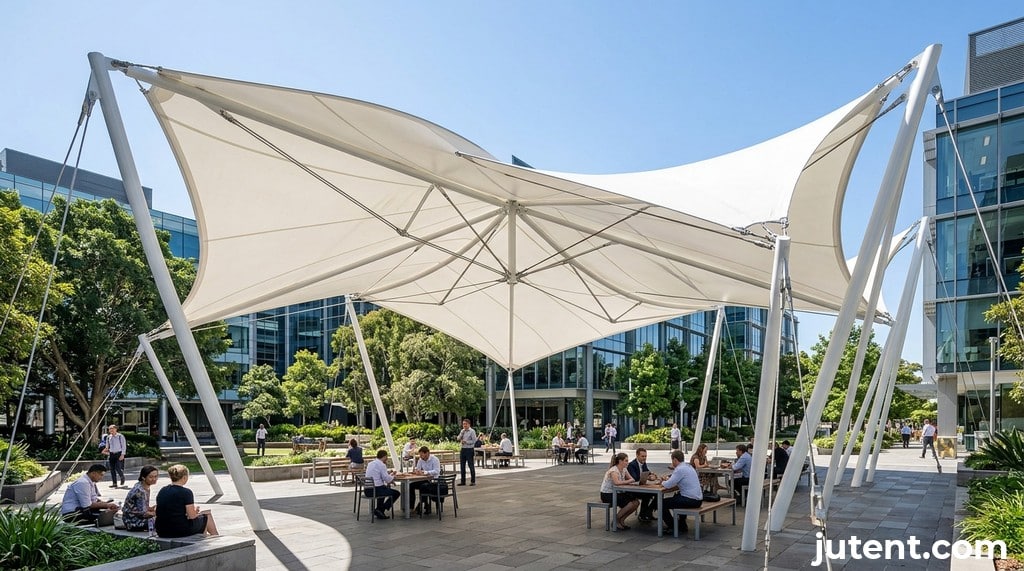
A park tensile shade structure is a permanent, architecturally designed tensile membrane structure specifically engineered for commercial applications within public park environments. These structures utilize the inherent strength and flexibility of tensioned fabric membranes, supported by a reliable steel framework, to create expansive, column-free shaded areas. Unlike temporary canopies or traditional rigid roof structures, a park tensile shade structure offers a unique blend of aesthetic appeal, durability, and functional performance. They are designed to withstand diverse weather conditions, including high winds and heavy rainfall, providing long-term protection and comfort.
What a park tensile shade structure isn't, however, is a temporary solution. These are engineered installations, requiring detailed design, structural calculations, and professional installation. They are not off-the-shelf kits for DIY assembly, nor are they suitable for short-term events where portability is a primary concern. Instead, they represent a significant investment in public infrastructure, intended to serve communities for decades. Their design prioritizes longevity, safety, and minimal maintenance, making them ideal for high-traffic public spaces suchike playgrounds, seating areas, and open plazas. For specific applications in park landscapes, Jutent offers tailored solutions. Park Landscapes
How Park Tensile Shade Structure Structures Work: Steel, Membrane, and Drainage
The fundamental principle behind a park tensile shade structure lies in the synergy between its primary components: the steel support structure and the tensioned membrane. The steel framework, typically constructed from high-grade Q235B or Q355B steel, provides the necessary anchor points and structural integrity. This steel is meticulously fabricated and treated with approved surface finishes such as epoxy zinc-rich primer + acrylic topcoat, epoxy zinc-rich primer + fluorocarbon topcoat, or hot-dip galvanizing to ensure long-term corrosion resistance and aesthetic appeal.
The membrane, usually a 1050 g/m² PVDF or PTFE fabric, is then stretched and tensioned across this framework. This tension is crucial; it gives the membrane its structural form and rigidity, allowing it to span large distances without intermediate supports. The specific shape of the membrane, often anticlastic (curving in opposite directions), is engineered to distribute loads effectively, resisting wind uplift and shedding rainwater.
Effective drainage is a critical design consideration. Tensile structures are inherently designed to manage rainwater efficiently. The membrane's curvature, combined with strategically placed low points and integrated gutter systems, directs water flow to specific drainage points, preventing ponding and ensuring the longevity of the structure. This intelligent design makes them highly suitable for environments with heavy rainfall. For a deeper dive into the technical aspects, refer to our thorough guide. Park Tensile Shade Structure Guide
Types of Park Tensile Shade Structure: Common Structural Forms
The versatility of tensile architecture allows for a wide array of structural forms, each offering distinct aesthetic and functional characteristics. Understanding these common types helps in selecting the most appropriate design for a specific park environment.
Cone Structures
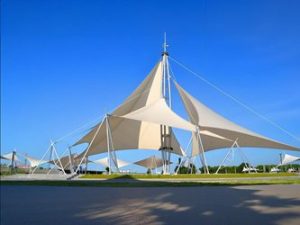
Cone structures are characterized by a central mast that pushes the membrane upwards, creating a conical or hyperbolic paraboloid shape. This form is excellent for shedding water and can create dramatic, soaring visual effects. They are often used for large, open areas where a single, prominent focal point is desired.
Arch Structures
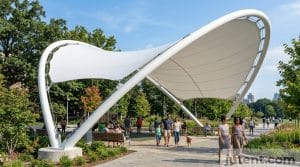
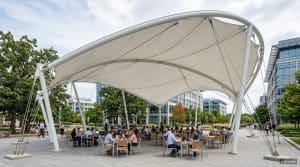
Arch structures utilize steel arches to support and tension the membrane. The membrane typically spans between parallel or radial arches, creating a vaulted or wave-like appearance. This form offers good clear spans and can be particularly effective for covering walkways or linear spaces, providing a sense of enclosure while maintaining openness.
Hypar (Hyperbolic Paraboloid) Structures
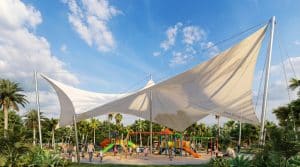
Hypar structures are perhaps the most iconic form of tensile architecture, known for their saddle-like shape. They are created by tensioning the membrane between high and low points, resulting in a double curvature that is inherently stable and efficient for water drainage. Hypars are highly adaptable and can be combined in modular arrangements to cover expansive areas, offering both aesthetic appeal and practical shade.
Barrel Vault Structures
Similar to arch structures, barrel vaults create a continuous, curved roofline. They are often supported by a series of parallel arches or trusses, with the membrane stretched over them to form a semi-cylindrical shape. These are effective for covering long, rectangular areas, providing consistent shade and a clean, modern aesthetic.
The choice among these types depends on factors such as the required coverage area, desired aesthetic, budget, and specific site conditions. Each form can be customized in terms of size, color, and detailing to integrate seamlessly with the surrounding park landscape.
What a Park Tensile Shade Structure Costs: A Realistic Range
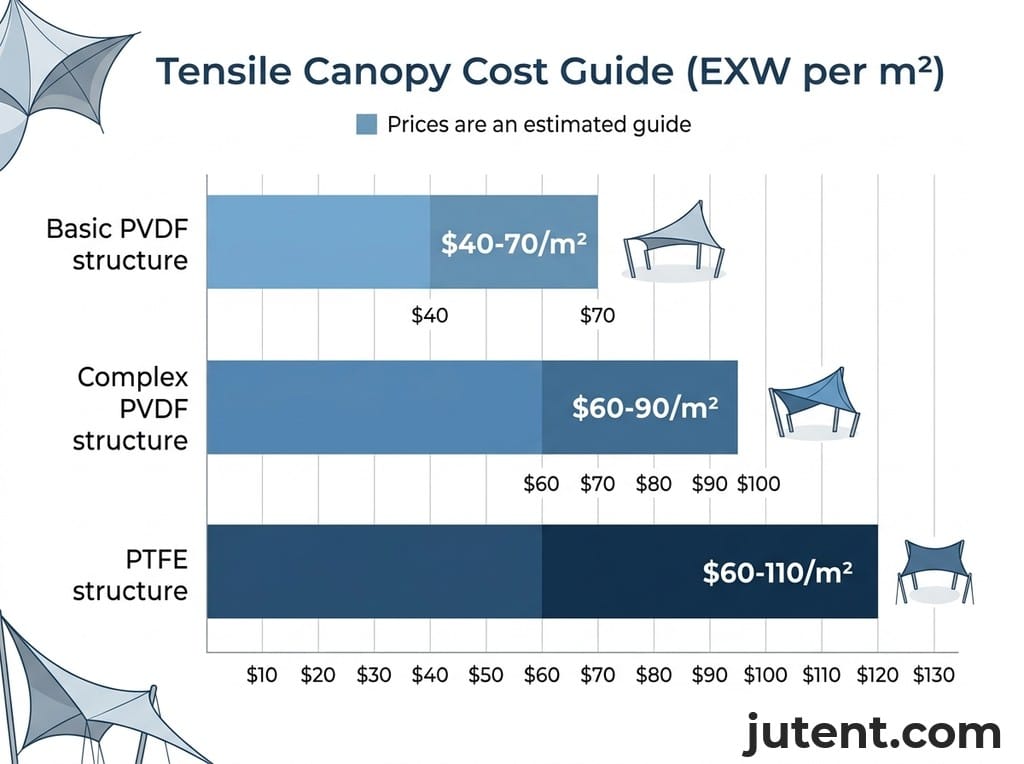
Understanding the cost implications of a park tensile shade structure is crucial for accurate project budgeting. Pricing for these engineered structures is typically quoted on a per square meter (m²) basis, reflecting the complexity of design, material choices, and fabrication requirements. It's important to note that these are EXW (Ex Works) prices and do not include shipping, installation, or local taxes. The minimum project scope Jutent undertakes is 100 m².
Here's a realistic cost range per square meter:
- Tensile membrane structure (minimal steel): For simpler designs where the membrane plays a more dominant structural role and requires less complex steelwork, costs can range from $30–$50/m².
- PVDF membrane, simple form: For structures utilizing standard PVDF membrane with straightforward geometric forms (e.g., basic hypars or small cones), expect a range of $40–$70/m².
- PVDF membrane, complex form: More intricate designs, larger spans, or structures with complex curvatures and custom steel detailing using PVDF membrane will typically fall within $60–$90/m².
- PTFE membrane: Opting for PTFE membrane, known for its exceptional longevity and self-cleaning properties, will add approximately $20/m² to the corresponding PVDF range. For example, a complex form with PTFE would be in the range of $80–$110/m².
These figures are general guidelines. Actual costs are subject to project-specific design, engineering requirements, membrane type (1050 g/m² PVDF or PTFE are standard), steel grade (Q235B, Q355B), and the complexity of the fabrication and installation process. For export projects, Jutent can provide design drawings, calculations, material specifications, installation manuals, and free remote guidance, subject to project scope and contract terms. On-site supervision is also available as a paid service.
When a Park Tensile Shade Structure Makes Sense for Your Project
Deciding whether a park tensile shade structure is the right fit for your project involves weighing its unique benefits against your specific needs and constraints. These structures are particularly advantageous in several scenarios:
Firstly, when enhancing user experience and comfort is a priority. In public parks, playgrounds, and outdoor gathering spaces, protection from harsh UV radiation and heat is essential for encouraging longer stays and greater enjoyment. A well-designed tensile structure provides significant shade, creating comfortable microclimates.
Secondly, for projects requiring large, column-free shaded areas. Traditional rigid structures often necessitate numerous support columns, which can obstruct views, limit flexibility, and create safety hazards in active public spaces. Tensile structures, with their ability to span vast distances with minimal supports, offer open, unobstructed spaces ideal for play areas, amphitheaters, or large seating zones.
Thirdly, when architectural distinction and aesthetic appeal are desired. The sculptural forms and dynamic lines of tensile structures add a modern, iconic element to any landscape. They can become signature features that define a park's identity and draw visitors. Based on Jutent's experience across 400+ projects in 30+ countries, these structures consistently elevate the visual impact of public spaces.
Finally, for projects demanding durability and low maintenance in public environments. Built with high-quality materials like SS304 (SS316 optional upgrade) for fittings and reliable membranes, these structures are engineered for longevity. With a 10-year warranty for PVDF membranes (15+ years service life) and a 15-year warranty for PTFE membranes (25+ years service life), coupled with steel structures designed for 25-30 years of service, they represent a sound long-term investment. The overall project typically comes with a 1-year warranty.
FAQ
- Q: How long does a park tensile shade structure last?
- A: The lifespan of a park tensile shade structure depends on its components. PVDF membrane has a typical lifespan of 15–20 years, often backed by a 10-year warranty. PTFE membrane offers superior longevity, with a service life of 25+ years and a 15-year warranty. The steel support structure, treated with approved surface finishes like hot-dip galvanizing, is designed to last 25–30 years, ensuring the overall durability of the installation.
- Q: Is a park tensile shade structure suitable for heavy rain environments?
- A: Yes, park tensile shade structures are highly suitable for heavy rain environments. Their unique architectural forms, particularly anticlastic shapes, are specifically engineered to shed rainwater efficiently. The tensioned membrane's curvature prevents water ponding, directing runoff to integrated drainage systems or designated low points. This intelligent design ensures effective water management, protecting the structure and the area beneath it from heavy precipitation.
If you're considering a park tensile shade structure, send us your project brief for a free consultation.