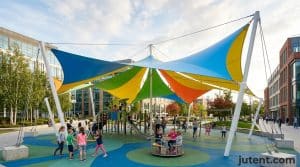

The afternoon sun beat down on the newly installed playground, its vibrant colors inviting but its surfaces already warming to the touch. A local council project manager, surveying the scene, knew the final piece of the puzzle was crucial: shade. The budget was tight, the area substantial, and the need for durable, effective UV protection paramount. The question wasn't if to provide shade, but how. Was a series of individual playground shade sails sufficient, or did the project demand the engineered elegance and expansive coverage of a tensile canopy? This common dilemma highlights the critical design factors that differentiate these two popular shade solutions, impacting everything from initial cost to long-term performance and safety.
What Playground Shade Sails Are and What They're Not
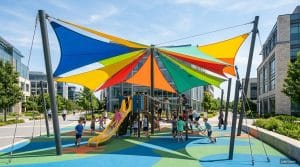
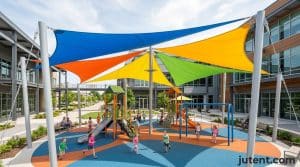
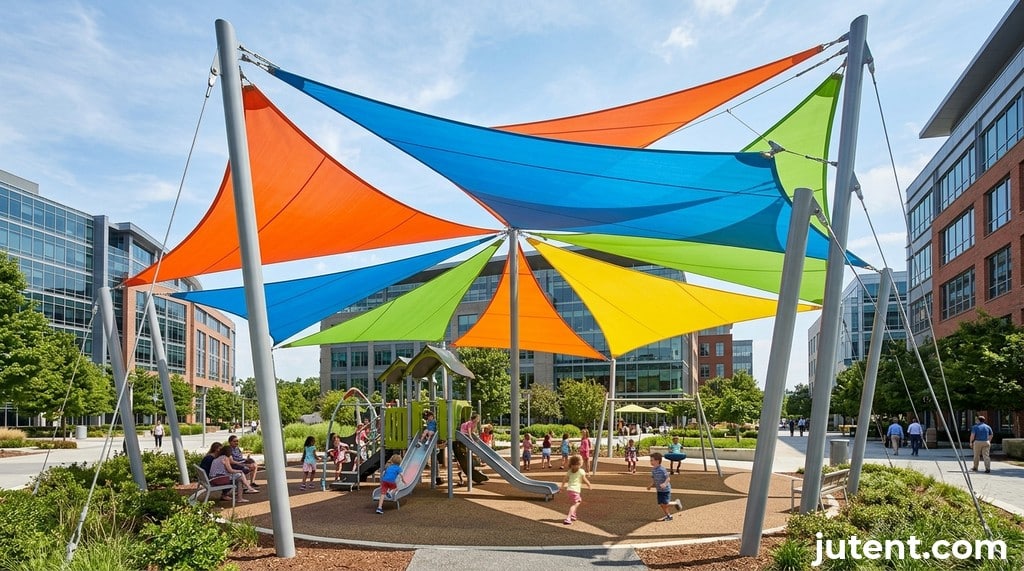
A playground shade sail is a fabric structure tensioned between multiple anchor points, typically poles or existing building facades, to create a shaded area. These sails are usually made from high-density polyethylene (HDPE) knitted fabric, which allows for air circulation, reducing heat buildup underneath. They are characterized by their often organic, free-form shapes, which can add an aesthetic appeal to a playground. The primary function of a commercial shade sail playground is to provide UV protection and reduce ambient temperature, making play areas safer and more comfortable for children. They are a cost-effective solution for covering smaller, discrete areas, offering flexibility in design and installation. [IMAGE: Playground shade sail]
However, it's crucial to understand what a playground shade sail is not. It is not a rigid, fully enclosed structure, nor is it designed for extreme weather conditions without specific engineering. Unlike a tensile canopy, which often features a reliable steel framework and a more durable, waterproof membrane, a shade sail relies on the tension of its fabric and the strength of its anchor points. While effective for sun protection, most standard shade sails are not fully waterproof, meaning they will not provide complete shelter from rain. Their design also means they typically require removal in very high winds or during winter in areas prone to heavy snow, unless specifically engineered for such loads. For more information on playground shade options, visit our dedicated page: Playground Shade
Span Limitations: How Large Can a Playground Shade Sail Be?
The size and span of a playground shade sail are inherently limited by the material properties of the shade cloth and the engineering principles governing its tensioning. While individual shade sails can be custom-fabricated, commercial playground shade sails are typically limited to a maximum panel size of approximately 6m x 6m. Exceeding this dimension with standard shade cloth significantly increases the risk of fabric stretching, sagging, and tearing under wind loads, compromising both effectiveness and safety. Larger areas often require multiple overlapping sails, which can introduce complex drainage issues and increase the number of support poles needed, potentially cluttering the play space.
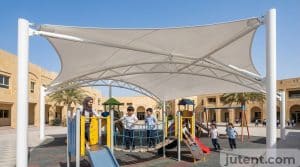
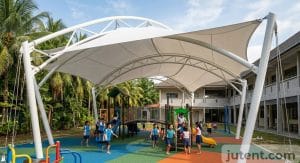
Tensile canopies, by contrast, are engineered structures designed for much larger spans. Utilizing high-strength membranes like PVDF or PTFE, supported by reliable steel frameworks (Q235B, Q355B), they can cover vast areas without intermediate supports. This allows for unobstructed play zones and greater design freedom. For example, a single tensile canopy can easily span 20m x 30m or more, a feat impossible for a single playground sail shade structure. The choice between a series of smaller shade sails and a single, expansive tensile canopy hinges on the required coverage area, desired aesthetic, and long-term durability goals. Based on Jutent's experience across 400+ projects in 30+ countries, the cost-effectiveness of a tensile canopy often becomes apparent for areas exceeding 100 m², offering superior longevity and performance.
| Feature | Playground Shade Sail | Tensile Canopy (PVDF/PTFE) |
|---|---|---|
| Typical Max Span | ~6m x 6m per panel | 20m x 30m+ (single structure) |
| Fabric Material | HDPE knitted fabric | PVDF or PTFE coated architectural membrane |
| Waterproof? | No (allows water through) | Yes (fully waterproof) |
| Wind Load | Limited; often requires seasonal removal | Engineered for specific wind zones; permanent installation |
| Service Life | 5-10 years (fabric) | 10-15+ years (PVDF), 25+ years (PTFE) |
| Cost (EXW/m²) | Lower for small areas | $40-$90/m² (PVDF), higher for PTFE |
For a deeper dive into various playground shade options, refer to our thorough guide: Playground Shade Structures Guide
Wind Load Performance: What Shade Sails Can and Cannot Handle
Wind load performance is a critical engineering consideration for any outdoor structure, especially those intended for public spaces like playgrounds. Playground shade sails, by their very nature, are designed to be permeable, allowing some air to pass through the fabric. This permeability helps reduce the direct force of wind compared to a solid surface. However, the large surface area of a sail, combined with its flexible nature, means it can still be subjected to significant uplift and lateral forces during high winds. Standard commercial shade sail playground installations are typically rated for moderate wind conditions. In areas prone to cyclonic activity or extreme gusts, these sails often require specific engineering for quick removal or a more robust, permanent design. Without proper engineering, high winds can cause fabric tearing, pole bending, or even anchor point failure, leading to costly damage and potential safety hazards.
Tensile canopies, conversely, are engineered from the ground up to withstand substantial wind loads. Their design incorporates a rigid steel framework (often Q235B or Q355B, with surface treatment options like epoxy zinc-rich primer + acrylic topcoat or hot-dip galvanizing) and high-strength architectural membranes (1050 g/m² PVDF or PTFE). The entire structure is precisely calculated to meet local building codes and specific wind zone requirements. This means a tensile canopy can be designed as a permanent fixture, capable of enduring severe weather events without requiring removal. The membrane's tension and the structural integrity of the steel framework work in concert to distribute wind forces efficiently, ensuring long-term stability and safety. For export projects, Jutent can provide design drawings, calculations, material specifications, installation manuals, and free remote guidance, subject to project scope and contract terms, ensuring compliance with local wind load requirements.
UPF Rating: What Commercial Shade Sails Achieve vs PVDF Membrane
The primary purpose of any playground shade structure is to protect children from the sun's harmful ultraviolet (UV) radiation. The effectiveness of this protection is measured by the Ultraviolet Protection Factor (UPF) rating. For commercial playground applications, a high UPF rating is non-negotiable, with UPF 50+ being the industry standard for excellent UV protection.
High-quality commercial playground shade sails, typically made from HDPE knitted fabric, are designed to achieve a UPF 50+ rating. This means they block over 98% of harmful UV radiation, offering significant protection. The knitted construction allows for air circulation, which is beneficial for temperature regulation, but it also means the fabric is not completely opaque. The UPF rating can be influenced by the fabric's color, weave density, and age. Over time, prolonged exposure to UV radiation can degrade the fabric, potentially reducing its UPF effectiveness, though quality materials are designed for longevity.
Architectural membranes used in tensile canopies, such as PVDF and PTFE, also achieve and often exceed UPF 50+ standards. PVDF membrane, for instance, provides excellent UV protection while offering superior durability and a longer service life (10-year warranty, 15+ years service life) compared to standard shade cloth. PTFE membrane offers even greater longevity (15-year warranty, 25+ years service life) and UV resistance. Unlike knitted shade cloth, these membranes are solid, non-permeable materials, meaning they block 100% of direct UV radiation and also provide complete waterproofing. This makes them ideal for environments where both sun and rain protection are required. While both options provide excellent UV protection, the architectural membranes offer a more reliable and longer-lasting solution, maintaining their UPF rating and structural integrity over a significantly extended period.
When to Choose a Shade Sail and When to Choose a Tensile Canopy
Deciding between a playground shade sail and a tensile canopy involves weighing several key factors related to project scope, budget, durability, and desired functionality.
Choose a Playground Shade Sail When:
* Budget is a primary constraint for smaller areas: Playground shade sails are generally more cost-effective for covering smaller, discrete play zones.
* Coverage area is limited: If you only need to shade a specific piece of equipment or a small seating area (typically under 36 m² per sail), individual sails are a viable option.
* Aesthetics prioritize a light, airy feel: The free-form, often colorful nature of shade sails can add a playful aesthetic.
* Seasonal removal is acceptable: In areas with extreme winter weather or very high winds, the ability to easily remove and store sails can be an advantage, provided the design accounts for this.
* Waterproofing is not a critical requirement: If the primary goal is sun protection and some air permeability is desired, shade sails are suitable.
Choose a Tensile Canopy When:
* Large, unobstructed coverage is needed: For expansive play areas (over 100 m²) where clear spans are essential, a tensile canopy is the superior choice.
* Long-term durability and minimal maintenance are priorities: With PVDF membranes offering a 10-year warranty and 15+ years service life, and PTFE even longer, tensile canopies represent a more permanent and reliable investment.
* All-weather protection is required: Tensile canopies provide both excellent UV protection (UPF 50+) and complete waterproofing, making them ideal for year-round use.
* High wind load resistance is critical: Engineered to specific wind zones, tensile canopies offer unparalleled structural integrity and safety in challenging weather conditions.
* A sophisticated, architectural statement is desired: The elegant forms and reliable engineering of tensile canopies can enhance the overall aesthetic and value of a public space.
* Minimum project scope is 100 m²: For projects of this size or larger, the cost-effectiveness and performance benefits of a tensile canopy often outweigh those of multiple shade sails. Typical technical values should always be written conservatively and described as subject to project design.
FAQ
- Q: What is the maximum size for a commercial playground shade sail?
- A: Commercial shade sails are typically limited to 6m × 6m per panel. Exceeding this dimension with standard shade cloth significantly increases the risk of fabric stretching, sagging, and tearing under wind loads. For larger areas, multiple overlapping sails are required, or a tensile canopy becomes a more structurally sound and durable solution, offering expansive, unobstructed coverage.
- Q: Do playground shade sails meet UPF 50+ standards?
- A: High-quality commercial shade cloth achieves UPF 50+, blocking over 98% of harmful UV radiation. However, PVDF membrane used in tensile canopies also achieves UPF 50+ with better durability and a significantly longer service life. PVDF membranes offer a 10-year warranty and 15+ years service life, maintaining their protective qualities and structural integrity for a much longer period compared to standard shade sail fabrics.
Tell us your playground dimensions and wind zone and we'll recommend shade sail or tensile canopy with a cost comparison.