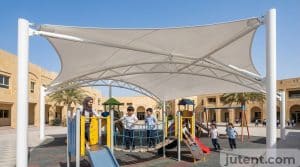

A playground shade structure is a permanent or semi-permanent cover that protects children from UV radiation and heat during outdoor play. This guide explains the types available, what they cost, and what UPF 50+ actually means.
When considering a playground shade structure, facility managers, council members, and parents face a critical decision: how to best protect children from the sun while enhancing their outdoor experience. This guide provides a framework for understanding the essential elements of playground shade, from defining what these structures are to breaking down costs and explaining critical safety standards. By understanding the different types, their benefits, and key considerations like UV protection and longevity, you can make an informed choice that prioritizes safety, durability, and budget for your school or community playground.
What a Playground Shade Structure Is and What It Isn't
A playground shade structure is a purpose-built architectural solution designed to provide significant protection from solar radiation and heat in outdoor play areas. Its primary function is to create a safe, comfortable environment for children, allowing extended play without excessive exposure to harmful UV rays. These structures are typically engineered with high-strength steel frames and specialized tensioned fabrics or membranes. They are distinct from temporary solutions like umbrellas or pop-up tents, which offer limited coverage, stability, and durability. Unlike natural shade from trees, which can be unpredictable and seasonal, a manufactured shade structure offers consistent, reliable protection over a defined area, designed to withstand various weather conditions.
Playground Shade
What a playground shade structure isn't is a simple awning or a makeshift cover. It is a carefully designed and engineered system, often requiring structural calculations and adherence to local building codes. It isn't a “one-size-fits-all” product; designs vary significantly based on the area to be covered, aesthetic requirements, and budget. The materials used, from the Q235B or Q355B steel frames to the 1050 g/m² PVDF or PTFE membranes, are selected for their longevity, UV resistance, and structural integrity. The steel components are treated with approved methods like hot-dip galvanizing or an epoxy zinc-rich primer with an acrylic or fluorocarbon topcoat to ensure decades of service life.
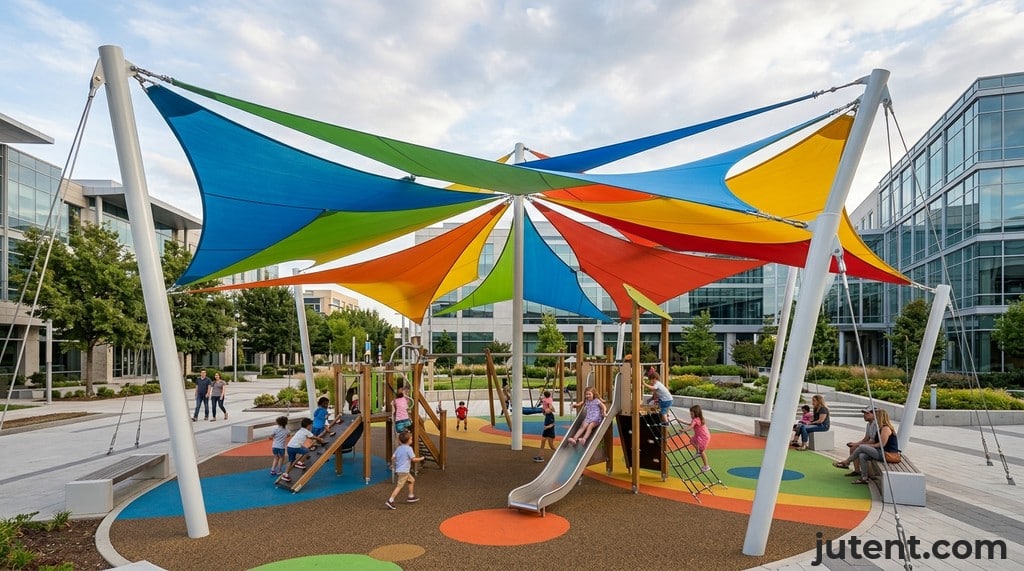
Types of Playground Shade: Shade Sails, Tensile Canopies, and Hip Roofs
Playground shade structures come in several distinct forms, each offering unique aesthetic and functional benefits. Understanding these types is crucial for selecting the right solution for your specific playground needs.
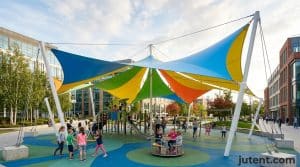
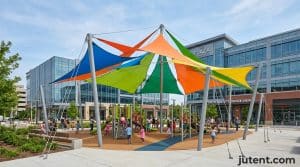
Shade Sails: These are perhaps the most visually dynamic and popular option for playgrounds. Comprising one or more pieces of tensioned fabric, typically high-density polyethylene (HDPE) or PVC, attached to multiple anchor points (posts or existing structures), shade sails create an artistic, flowing aesthetic. They are excellent for covering irregular areas and can be overlapped to create multi-layered shade. Their open design allows for good airflow, reducing heat build-up underneath.
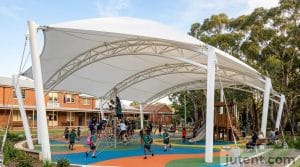
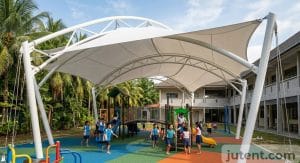
Tensile Canopies: Tensile canopies represent a more engineered and often larger-scale solution. These structures utilize a pre-stressed membrane (commonly PVDF or PTFE) stretched over a steel framework to create distinctive, often sculptural forms. They offer superior weather protection, including rain, and can cover vast areas with minimal internal supports. Their architectural elegance makes them suitable for prominent public spaces.
Hip Roofs (or Hypar Structures): These structures feature a more traditional, often four-sided roof shape, but constructed with tensioned fabric. They provide consistent, uniform shade over a rectangular or square area. Hip roofs are known for their reliable appearance and excellent coverage, making them a practical choice for defined play zones. They are structurally sound and offer reliable protection against both sun and rain.
Each type offers varying degrees of design flexibility, coverage area, and weather resistance. The choice often depends on the specific site conditions, desired aesthetic, and the level of protection required.
Playground Shade Structures Guide
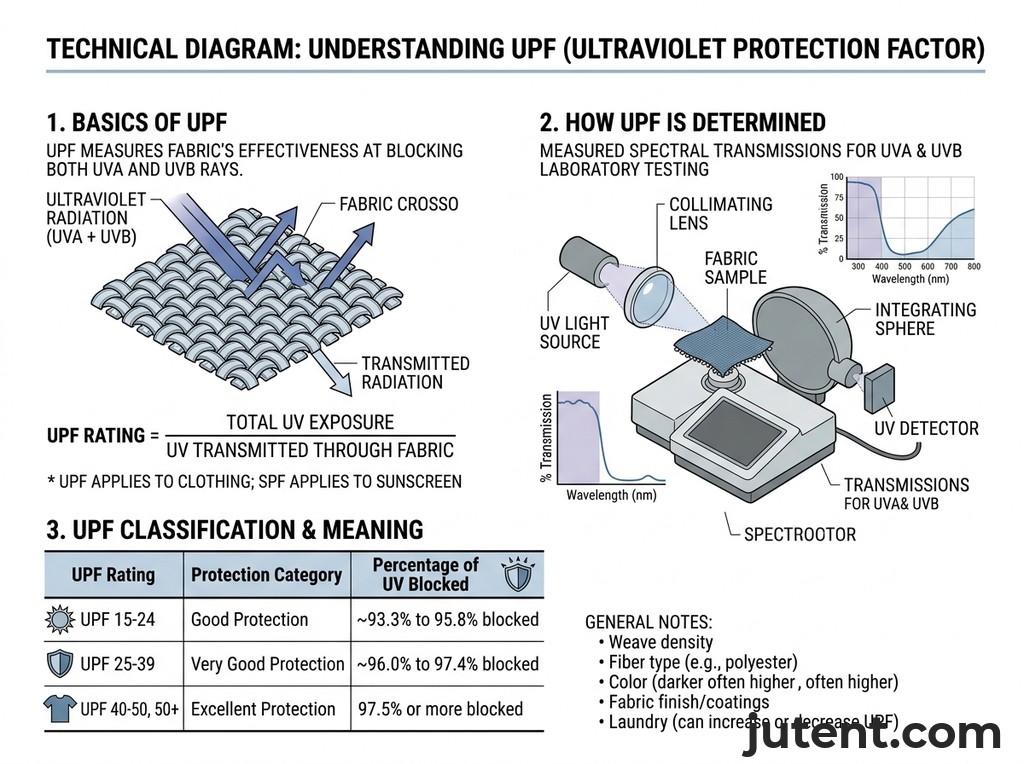
What UPF 50+ Means and Why It Matters for Playground Shade
Understanding Ultraviolet Protection Factor (UPF) is paramount when selecting playground shade. UPF is a rating system used for fabrics that indicates how effectively they block ultraviolet (UV) radiation. A UPF rating of 50+ means the fabric allows less than 2% of UV radiation to pass through, effectively blocking 98% or more of both UVA and UVB rays. This level of protection is considered excellent and is the highest rating achievable for textiles.
Why does UPF 50+ matter so significantly for playground shade? Children's skin is particularly vulnerable to sun damage. Exposure to UV radiation, especially during childhood, is a major risk factor for skin cancer later in life. Prolonged sun exposure can also lead to sunburn, heatstroke, and eye damage. By installing a playground shade structure with a UPF 50+ rated membrane, schools and councils are providing a critical layer of defense against these health risks.
This high level of UV protection ensures that children can play outdoors for extended periods without the immediate danger of sunburn or the long-term risk of skin damage. It empowers parents and educators with the confidence that the play environment is safe. For example, the Cancer Council Australia strongly recommends UPF 50+ for all school and public playground shade structures, highlighting its importance in public health guidelines. When evaluating materials like 1050 g/m² PVDF or PTFE membranes, their inherent UPF 50+ properties are a non-negotiable safety feature, ensuring the structure fulfills its primary purpose: protecting the next generation.
What a Playground Shade Structure Costs: A Realistic Range
The cost of a playground shade structure is influenced by several factors, including the type of structure, the membrane material, the complexity of the design, and the overall project scope. It's important to understand that pricing is typically quoted per square meter (m²) of covered area, and minimum project scopes usually start at 100 m².
For simpler tensile membrane structures with minimal steel framework, you can expect a range of $30–$50/m² (EXW). This might include basic shade sails or very straightforward canopy designs.
When moving to PVDF membrane structures with simple forms, such as standard hip roofs or basic tensile canopies, the cost generally falls between $40–$70/m² (EXW). These structures offer excellent durability and a 10-year warranty on the PVDF membrane, with a service life of 15+ years.
For more complex PVDF membrane structures, featuring intricate designs, larger spans, or unique architectural forms, the price range increases to $60–$90/m² (EXW). These projects often involve more extensive engineering and fabrication.
If you opt for PTFE membrane, known for its exceptional longevity and self-cleaning properties, expect to add approximately $20/m² to the PVDF ranges. PTFE membranes typically come with a 15-year warranty and a service life of 25+ years.
These figures are EXW (Ex Works) and do not include shipping, installation, or local permits. For export projects, Jutent can provide design drawings, calculations, material specifications, installation manuals, and free remote guidance, subject to project scope and contract terms. On-site supervision is also available as a paid service. The steel components, typically Q235B or Q355B, are treated with hot-dip galvanizing or an epoxy zinc-rich primer with an acrylic or fluorocarbon topcoat, ensuring a long service life for the overall structure.
When to Choose Each Type for Your Playground
Selecting the right playground shade structure involves matching the specific needs of your site with the characteristics of each shade type.
Shade Sails are ideal for projects with a focus on aesthetic appeal and flexible coverage. Choose shade sails when:
* You want a dynamic, modern look that can be customized with multiple colors and overlapping designs.
* You need to shade irregular areas or integrate with existing playground equipment.
* Good airflow is a priority, as their open design prevents heat trapping.
* Your budget is more constrained, as they can sometimes be a more cost-effective option for smaller areas.
* You're looking for a solution that offers excellent UV protection (UPF 50+) but where complete rain protection isn't the primary concern.
Tensile Canopies are best suited for larger, more architecturally significant projects requiring extensive, durable coverage and superior weather protection. Opt for tensile canopies when:
* You need to cover a very large area, such as an entire play zone or outdoor learning space.
* Rain protection is as important as sun protection.
* You desire a striking, sculptural aesthetic that makes a statement.
* Long-term durability and minimal maintenance are key, leveraging the 10-year (PVDF) or 15-year (PTFE) membrane warranties and reliable steel frames.
* The project demands high engineering precision and structural integrity, often for public spaces with high foot traffic.
Hip Roofs offer a practical, reliable solution for defined play areas where consistent, uniform shade and strong structural presence are desired. Consider hip roofs when:
* You need to shade a specific, often rectangular or square, play area with clear boundaries.
* A more traditional, solid-looking structure is preferred over a flowing design.
* Maximum, consistent shade coverage over the footprint is essential.
* You require excellent protection from both sun and rain.
* The site benefits from a sturdy, permanent fixture that blends well with existing architecture.
Based on Jutent's experience across 400+ projects in 30+ countries, the most successful projects carefully balance these factors with budget and local climate conditions to ensure the chosen shade structure meets all functional and aesthetic requirements.
FAQ
- Q: What is UPF 50+ and why does it matter for playground shade?
- A: UPF 50+ (Ultraviolet Protection Factor) indicates that a fabric blocks 98% or more of harmful UV radiation. This is crucial for playground shade because children's skin is highly susceptible to sun damage, which can lead to sunburn, heatstroke, and significantly increase the risk of skin cancer later in life. By providing UPF 50+ shade, schools and councils ensure a safe play environment, aligning with recommendations from health organizations like Cancer Council Australia for all public and school playground shade structures.
- Q: How long does a playground shade structure last?
- A: The lifespan of a playground shade structure depends on its components. A high-quality PVDF membrane, typically 1050 g/m², has a service life of 15–20 years, backed by a 10-year warranty. For PTFE membranes, the service life extends to 25+ years with a 15-year warranty. The steel posts, fabricated from Q235B or Q355B steel and treated with hot-dip galvanizing or an epoxy zinc-rich primer with a fluorocarbon topcoat, are designed for a service life of 25–30 years. Overall project warranty is typically 1 year. Typical technical values should always be written conservatively and described as subject to project design.
If you're considering a playground shade structure for a school or public space, send us your project brief for a free consultation.