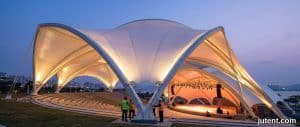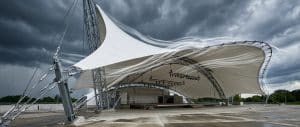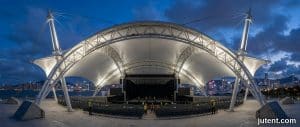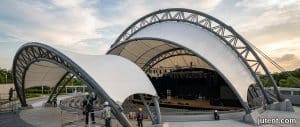

An outdoor stage canopy cost typically ranges from $20,000 for a small community stage to over $150,000 for a large performance venue — a range wide enough to make budgeting nearly impossible without knowing what drives the difference. Venue developers and contractors often receive initial estimates that vary by 40% or more for the exact same footprint. The variance is rarely about supplier margins; it is almost entirely about structural assumptions. A 15m × 10m stage cover designed to support 2,000kg of suspended lighting and audio equipment requires a fundamentally different steel frame than a purely architectural canopy of the exact same dimensions. This guide breaks down the specific variables that dictate a stage canopy budget, from rigging loads and span requirements to membrane grades and supply scopes, giving you the hard numbers needed to plan a realistic project budget before you go to tender. Knowing these factors prevents budget blowouts and ensures the structure you specify is actually the structure you need.
The 5 Factors That Drive Outdoor Stage Canopy Cost
Five primary variables dictate the final price of tensile stage canopy. The first is the physical footprint and clearance height. A canopy requiring a 10-metre apex clearance demands significantly heavier steel columns and deeper foundation footings than one with a standard 6-metre clearance just to resist lateral wind loads. The second factor is the rigging load capacity. A structure engineered to suspend 3,000kg of line arrays and lighting trusses requires thicker steel profiles and reinforced connection nodes compared to a purely static shade structure.
The final technical values should be confirmed against the project-specific engineering requirements and local code conditions.
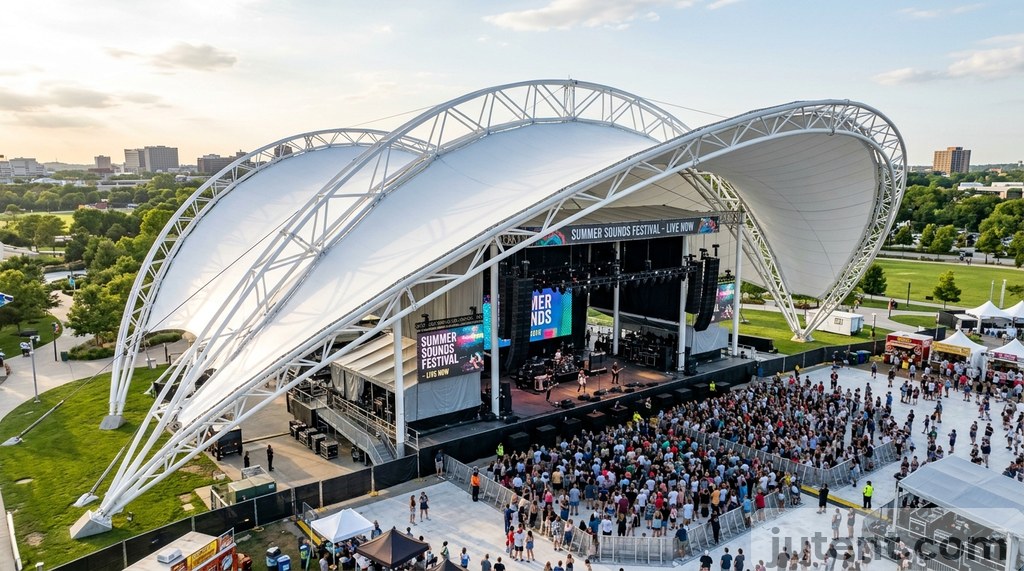
Outdoor Stage Canopy Cost Breakdown by Size and Rigging Load
Cost by Stage Size: Small Community Stage vs Large Performance Venue
Stage cover price scales non-linearly with size because wider clear spans require exponentially heavier primary steel to prevent deflection. A small community stage, typically around 10m × 8m, generally costs between $20,000 and $35,000 supply-only. These structures usually employ standard portal frames or simple saddle-tensioned membranes and are designed for minimal suspended loads, keeping steel tonnage low.
Based on Jutent's experience across 400+ projects in 30+ countries, similar specification issues often appear when early-stage assumptions are made before the engineering conditions are confirmed.
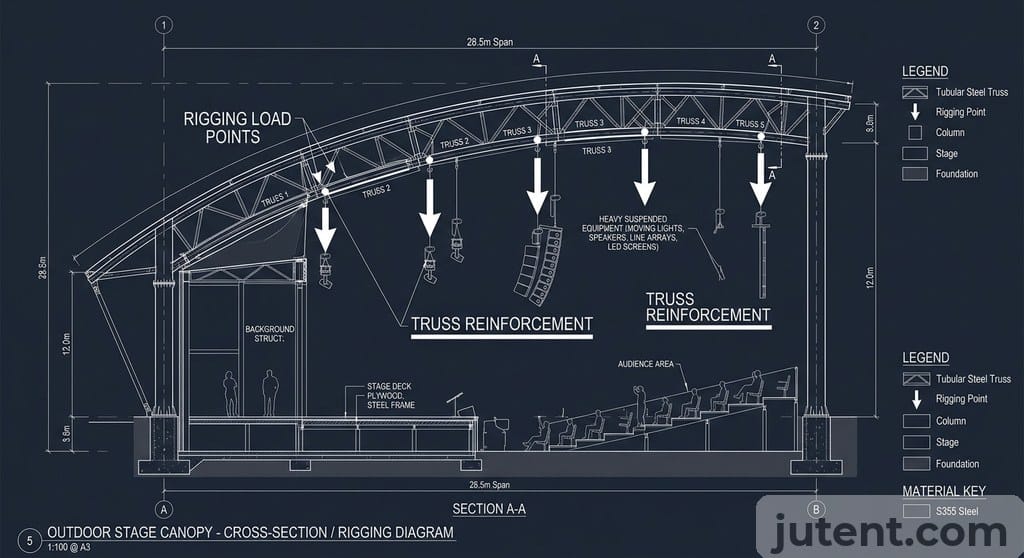
Rigging Load Requirements: How They Affect Structural Cost
Rigging capacity is the most underestimated driver of tensile stage structure cost. A canopy is not just a roof; for professional venues, it is a load-bearing grid. If a contractor specifies a canopy based solely on square meterage without defining the suspended equipment weight, the resulting quote will be dangerously inaccurate.
A standard architectural canopy is engineered to support its own dead weight plus environmental loads like wind and snow. When you add a requirement to hang 1,500kg of lighting trusses, LED screens, and audio line arrays, the structural engineering changes entirely. The primary arches or trusses must be sized to handle point loads at specific nodes to prevent localized buckling.
Adding a 2,000kg rigging capacity to a 15m × 10m stage typically increases the total structural cost by 25–35%. This premium covers the heavier steel profiles, reinforced base plates, and the specialized welded connection points required for safe rigging. To control your stage canopy budget, define the exact audio-visual payload before requesting a quote. Specifying “heavy duty” is meaningless to an engineer; specifying “four 250kg point loads at the front arch” allows for precise, cost-efficient steel sizing. Over-engineering the rigging capacity wastes money, while under-engineering it creates severe safety liabilities during live events.
Supply-Only vs Supply-and-Install: Understanding the Price Difference
Pricing should be reviewed by product category and project scope rather than treated as a fixed published number. For an accurate quotation, the structure size, wind rating, membrane grade, and delivery terms should be confirmed first.
Supply-and-install contracts include site labor, lifting equipment, and project management, which can easily double the total cost. For international projects, sending a specialized installation crew from the manufacturer adds significant travel, accommodation, and daily rate expenses.
The most cost-effective procurement method for contractors is a supply-only agreement paired with technical supervision. In a recent amphitheater project in Southeast Asia, the contractor utilized their own local steel erectors and crane operators, while we provided a single technical supervisor for six days to oversee the membrane tensioning sequence. This hybrid approach saved the client over $28,000 in