
New Zealand's unique climate, with its intense UV radiation and often unpredictable weather patterns, presents specific challenges for school infrastructure. For contractors tasked with installing a school walkway canopy in New Zealand, understanding and adhering to local standards is not just a recommendation – it's a legal and ethical imperative. From ensuring student safety against the sun's harsh rays to designing structures that withstand significant wind loads, every specification matters. This article guides New Zealand contractors through the essential requirements for compliant and durable school covered walkways, helping you navigate the complexities of local regulations and international sourcing.
UPF 50+ UV Protection: What NZ Standards Require for School Walkways
Protecting students from New Zealand's high UV levels is paramount, making UV protection a critical specification for any school walkway canopy. The country experiences some of the highest UV radiation levels globally, necessitating stringent standards for outdoor shade structures. For school covered walkways, the fabric membrane must provide a minimum Ultraviolet Protection Factor (UPF) of 50+. This standard ensures that the canopy effectively blocks over 98% of harmful UV radiation, offering a safe passage for students between buildings.
When specifying materials, contractors must request UPF 50+ certification from the membrane supplier. This certification typically comes from independent testing laboratories, verifying the fabric's ability to meet the required protection level. Common tensile membrane materials like PVDF (Polyvinylidene Fluoride) are excellent choices, often exceeding this requirement while offering long service life. A standard 1050 g/m² PVDF membrane, for instance, provides superior UV resistance and durability. Ensuring this level of protection is not just about compliance; it's about safeguarding the health of students and staff daily. School Walkways
NZS 1170.2: The Cornerstone of Structural Integrity
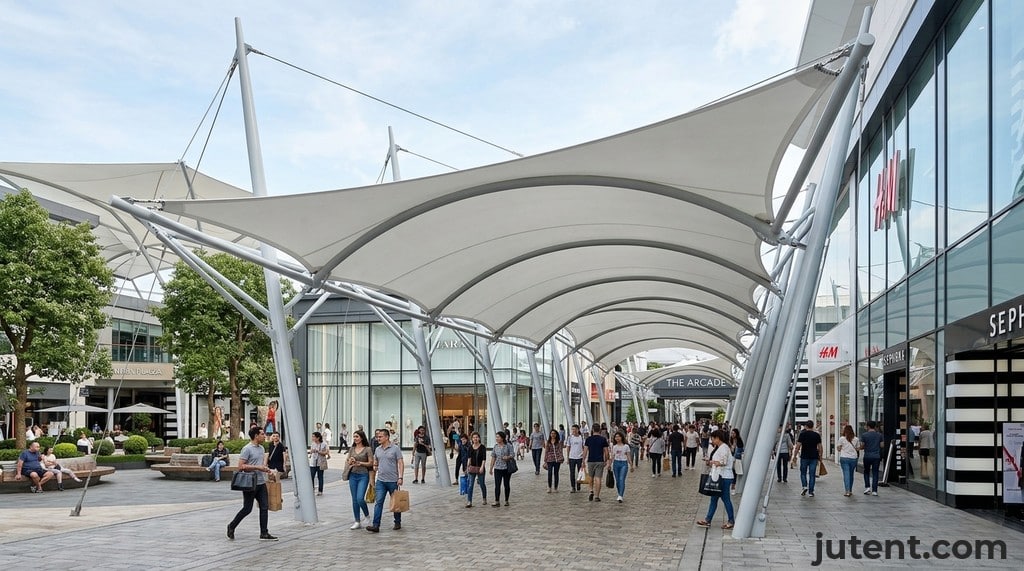
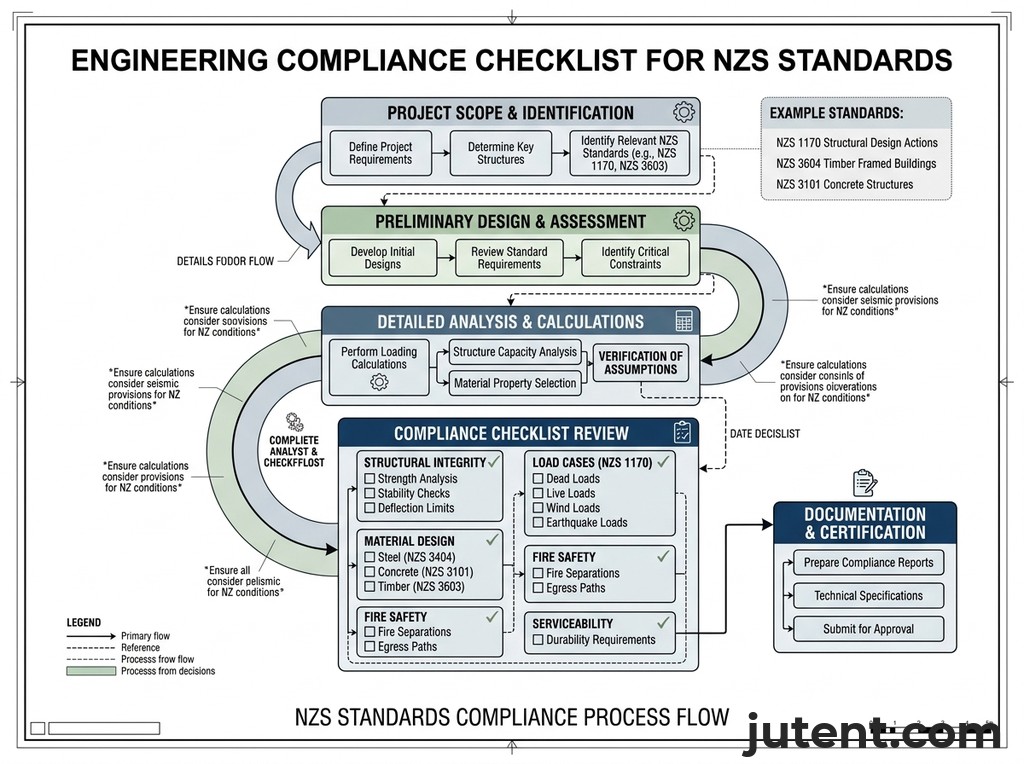
Beyond UV protection, the structural integrity of a school walkway canopy in New Zealand is governed by the NZS 1170 series of standards, particularly NZS 1170.2 for wind actions. This standard dictates how structures must be designed to withstand the specific wind conditions prevalent across different regions of New Zealand. For contractors, this means that every aspect of the canopy's design – from the steel framework to the membrane attachment points – must be engineered to meet these precise wind load requirements.
Compliance with NZS 1170.2 is non-negotiable for obtaining building consent and ensuring the long-term safety and stability of the structure. It requires detailed engineering calculations that consider the canopy's location, height, terrain category, and the regional basic wind speed. Manufacturers supplying structures to New Zealand must be capable of providing these calculations, ideally stamped by a New Zealand-registered structural engineer. Based on Jutent's experience across 400+ projects in 30+ countries, we understand the critical importance of tailoring designs to local building codes, ensuring that our tensile structures meet or exceed these rigorous standards. School Walkway Canopy Guide
Wind Load Requirements for New Zealand School Walkways
New Zealand's diverse topography and exposure to strong weather systems, including cyclones and southerly gales, mean that wind load requirements for school walkway canopies are among the most stringent globally. NZS 1170.2 specifies the methodology for determining design wind actions, which vary significantly depending on the site's location (e.g., coastal, urban, sheltered valley), its terrain category (e.g., open, suburban, city), and the structure's height and geometry.
For a school walkway canopy, contractors must provide the exact project location to the manufacturer. This allows for precise calculation of the ultimate limit state (ULS) and serviceability limit state (SLS) wind pressures. These calculations will dictate the required steel grades (e.g., Q235B, Q355B), section sizes, and connection details. For instance, a school walkway canopy Auckland might face different wind pressures than one in Wellington or Christchurch due to varying basic wind speeds and terrain characteristics. The design must account for both positive and negative pressures (uplift) on the membrane and frame. A reputable manufacturer will provide detailed engineering drawings and calculations, demonstrating full compliance with NZS 1170.2, ensuring the structure can safely withstand the maximum anticipated wind events over its service life.
Council Approval: What Documentation Is Typically Required in NZ
Securing council approval is a crucial step for any school walkway canopy installation in New Zealand. The specific documentation required can vary slightly between local councils, but a core set of documents is universally expected to demonstrate compliance with the Building Act 2004 and relevant NZS standards. Contractors should prepare for a thorough submission process.
Typically, the following documentation will be required: detailed architectural drawings (site plans, elevations, sections), structural engineering drawings and calculations (stamped by an NZ-registered engineer, demonstrating compliance with NZS 1170.2 and other relevant standards), a producer statement (PS1 – Design, and potentially PS3 – Construction Review), material specifications (including UPF 50+ certification for the membrane and surface treatment details for steel, such as epoxy zinc-rich primer + acrylic topcoat or hot-dip galvanizing), and a construction methodology. Councils will also assess the project against district plan rules, including site coverage, setbacks, and visual amenity. Engaging with the local council early in the planning phase can help streamline the approval process and identify any specific local requirements or considerations unique to the project's location.
Sourcing from China: What NZ Contractors Need to Verify
Sourcing a school walkway canopy from China can offer cost efficiencies, but New Zealand contractors must exercise due diligence to ensure compliance with local standards. The key is to partner with manufacturers who have a proven track record of exporting to regulated markets and who understand the specific requirements of NZS.
The most critical verification points include:
1. Engineering Compliance: The manufacturer must provide structural engineering drawings and wind load calculations explicitly referencing NZS 1170.2. Crucially, these calculations and drawings must be reviewed and stamped by a New Zealand-registered structural engineer. Without this, council approval will not be granted.
2. Material Specifications: Verify that the membrane material meets UPF 50+ standards and that the steel (e.g., Q235B, Q355B) is treated with approved surface treatments like hot-dip galvanizing or epoxy zinc-rich primer + fluorocarbon topcoat for corrosion resistance in NZ's climate.
3. Quality Certifications: Look for manufacturers with international quality certifications like ISO 9001 and SGS, indicating reliable quality control processes.
4. Documentation for Export: For export projects, Jutent can provide design drawings, calculations, material specifications, installation manuals, and free remote guidance, subject to project scope and contract terms. This thorough documentation package is essential for smooth customs clearance and council approval.
5. Warranty: Ensure the manufacturer offers a suitable warranty, typically 1 year for the overall project and 10 years for PVDF membranes, with a service life of 15+ years.
Cost Benchmarks: School Walkway Canopy Supply Cost in New Zealand
Understanding the cost benchmarks for a school walkway canopy in New Zealand, particularly when sourcing internationally, is vital for accurate project budgeting. The supply cost from China typically refers to the ex-factory price (EXW) and does not include shipping, customs duties, local installation, or council fees.
For a standard school walkway canopy (e.g., 20–50m run, 3-4m width), the supply cost from China for the structure and membrane materials can range from $18,000–$50,000 NZD ex-factory. This range is influenced by several factors:
* Size and Complexity: Larger or more architecturally complex designs will naturally incur higher costs.
* Membrane Type: PVDF membrane is standard, with a typical price range of $40–$70/m² for simple forms and $60–$90/m² for complex forms. PTFE membrane will add approximately $20/m² to these ranges.
* Steel Grade and Surface Treatment: While Q235B and Q355B are standard, specific design requirements or upgrades to SS316 for coastal environments will impact cost. Hot-dip galvanizing or multi-layer epoxy/fluorocarbon paint systems are standard and included.
* Minimum Project Scope: Most manufacturers, including Jutent, have a minimum project scope of 100 m² for tensile membrane structures.
* Ancillary Components: Costs can also vary based on the inclusion of integrated lighting, drainage systems, or specific connection details.
These figures represent the supply cost for the manufactured components. Contractors must factor in freight, customs, local engineering review, installation labor, and any necessary groundworks to arrive at a total project cost.
FAQ
- Q: Do school walkway canopies from China meet New Zealand standards?
- A: Yes, if the manufacturer provides engineering drawings stamped by a registered NZ engineer and wind load calculations to NZS 1170.2. Reputable Chinese manufacturers, like Jutent, are experienced in exporting to regulated markets and can provide the necessary documentation, including material specifications and quality certifications (e.g., ISO 9001, SGS). It is crucial for contractors to verify these documents and ensure they are specific to the project's location and New Zealand's unique building codes.
- Q: What is the cost of a school walkway canopy in New Zealand?
- A: Supply cost from China typically ranges from $18,000–$50,000 NZD ex-factory for a standard school walkway (20–50m run). This price covers the manufactured structure and membrane. Additional costs will include shipping, customs duties, local engineering review, council fees, and on-site installation. The final cost depends on factors such as the canopy's size, design complexity, membrane type (PVDF or PTFE), and specific steel treatments.
Tell us your project location in New Zealand and we'll provide NZS-compliant wind load calculations and a cost estimate.