
Designing effective transit and parking infrastructure requires more than mere surface coverage; it demands a rigorous analysis of vehicular circulation, thermal dynamics, and structural geometry. A high-performance commercial canopy must integrate seamlessly into the built environment while enduring intense wind loads, UV radiation, and daily operational wear. At Jutent, we approach tensile car park shade structures not as static off-the-shelf tents, but as finely engineered architectural solutions. By categorizing structural parameters according to specific vehicle types, we engineer tensile systems that maximize usable space, drastically reduce the risk of collision, and elevate the aesthetic value of the facility.
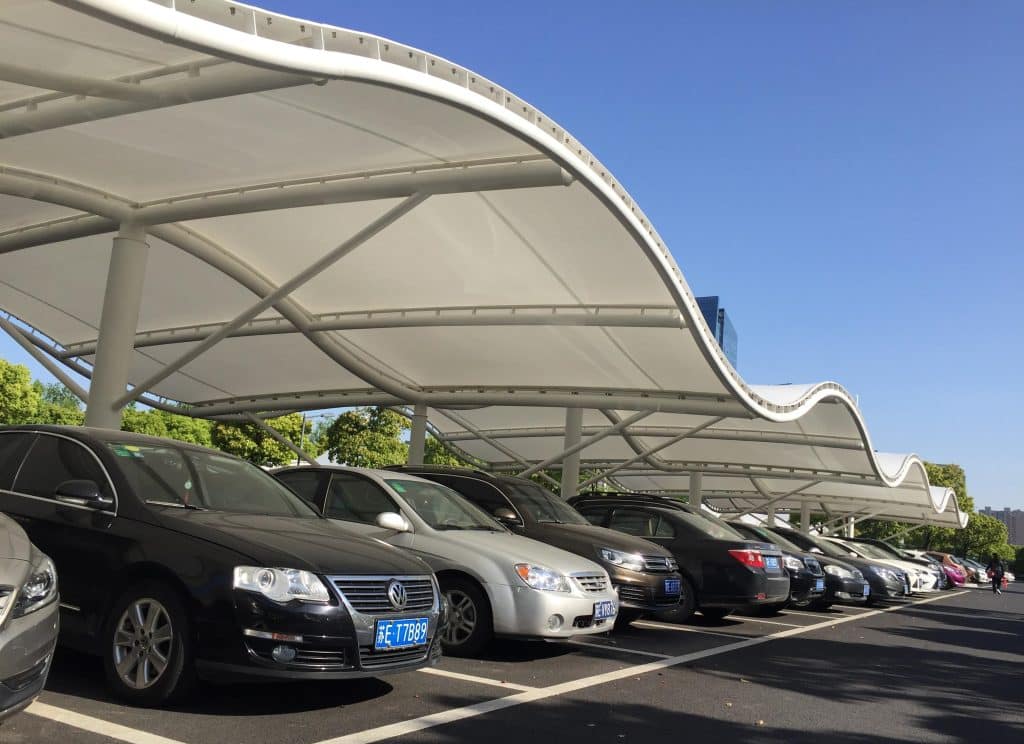
Passenger Vehicles: Spatial Efficiency & Span Optimization
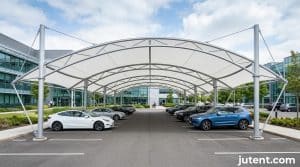
For standard passenger car bays, structural efficiency is dictated by the precise calibration of column placement versus roof span. Traditional steel or polycarbonate roofing often introduces intrusive support columns that bottleneck circulation and increase the likelihood of vehicular damage.
In contrast, an engineered architectural membrane structure utilizes cantilevers or large-span arches supported by heavy-duty Q355B steel. By leveraging the dual curvature of the tensile membrane, these structures achieve vast protective spans with a minimized footprint. This structural logic keeps columns safely positioned at the rear or between designated parking modules, ensuring unrestricted door clearance and smooth turning radii.
EV Charging Hubs: Thermal Mitigation & Equipment Protection
Electric Vehicle (EV) charging stations introduce a critical variable to canopy design: strict temperature control. Heat accumulation from direct solar radiation can severely impact the performance and longevity of high-voltage charging units, while also creating an uncomfortable environment for users.
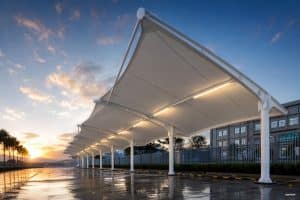
To combat this, we specify PVDF-coated PVC or advanced PTFE membranes. These materials offer exceptional solar reflectance, significantly lowering the ambient temperature beneath the structure. Furthermore, the 10% to 15% light transmission of these technical fabrics provides natural, diffused daytime illumination—eliminating harsh glare on digital displays while reducing the need for artificial lighting during the day. The aerodynamic form of the fabric roofing also promotes passive airflow, ensuring that heat generated by the transformers and vehicles quickly dissipates.
Large-scale tensile structures are inherently kinetic. Our engineers utilize computational fluid dynamics (CFD) and form-finding software to sculpt the membrane shape. By maintaining precise pre-tensioning via stainless steel catenary cables, the canopy safely deflects uplift forces and sheds heavy snow loads, ensuring the structural membrane remains taut and secure even in extreme microclimates.
Bus Depots & Commercial Fleets: High-Clearance Engineering
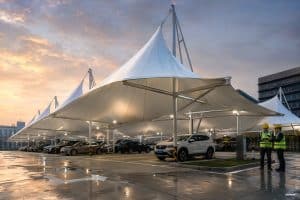
Designing for bus terminals, logistics depots, and municipal fleets requires immense spatial clearance. Conventional roofing materials become excessively heavy and economically unviable at these scales. A custom tensile system excels here, offering an unparalleled strength-to-weight ratio.
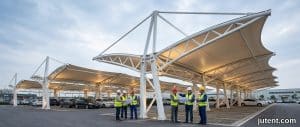
Utilizing robust mast-and-cable configurations, we engineer massive, unobstructed spans that accommodate the turning paths and heights of commercial vehicles. The lightweight nature of the structural membrane drastically reduces the dead load on the foundation, which accelerates the construction timeline and controls capital expenditure—making it the premier choice for large-scale commercial canopies.
Bicycles & Micro-Mobility: Minimalist Anchor Systems
Micro-mobility hubs require a lighter touch. Bicycle and scooter shelters benefit from highly modular, minimalist designs that integrate easily into urban streetscapes, university campuses, or transit stations.
Because the required clearance is lower, the steel framework can be slender, utilizing smaller, localized foundation footings. The self-cleaning properties of the membrane's topcoat ensure that these low-clearance structures maintain a pristine, modern aesthetic with virtually zero maintenance, preventing the accumulation of dirt and urban pollutants.
Fire Safety & Membrane Durability
Compliance with international safety standards is non-negotiable in architectural design. Whether dealing with a compact residential setup or a massive commercial plaza, material integrity defines the lifespan of the project.
- Fire Performance: Our structural fabrics meet rigorous fire-retardant standards (such as NFPA 701, DIN 4102 B1). They are engineered to self-extinguish and will not produce flaming droplets, protecting the high-value assets parked beneath.
- Long-Term Durability: Depending on the specified material (from premium PVC to fiberglass-backed PTFE), a well-maintained Jutent tensile canopy offers a functional lifespan of 15 to over 30 years.
- Corrosion Resistance: The Q355B structural steel is treated with industrial-grade hot-dip galvanization and finished with epoxy zinc-rich primers to withstand harsh outdoor environments indefinitely.
Standardized templates cannot account for the nuanced realities of site topography, vehicle behavior, and local wind codes. A successful tensile car park shade structure is the result of rigorous structural engineering, precision fabrication, and deep material knowledge.