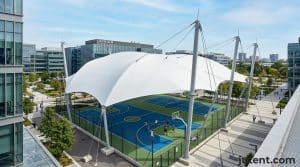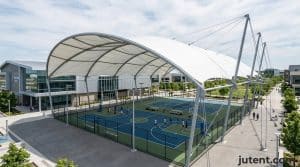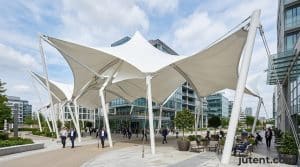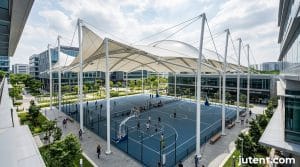

A sports court tensile canopy installation involves distinct phases: foundation work, steel erection, and membrane tensioning. Each phase demands specific skills and coordination. This guide clarifies what Jutent Engineering, as the manufacturer, provides and what your site team needs to prepare and execute for a successful sports court tensile canopy installation. Understanding these responsibilities upfront ensures a smooth project timeline and avoids costly delays.
The Four Phases of a Tensile Canopy Installation
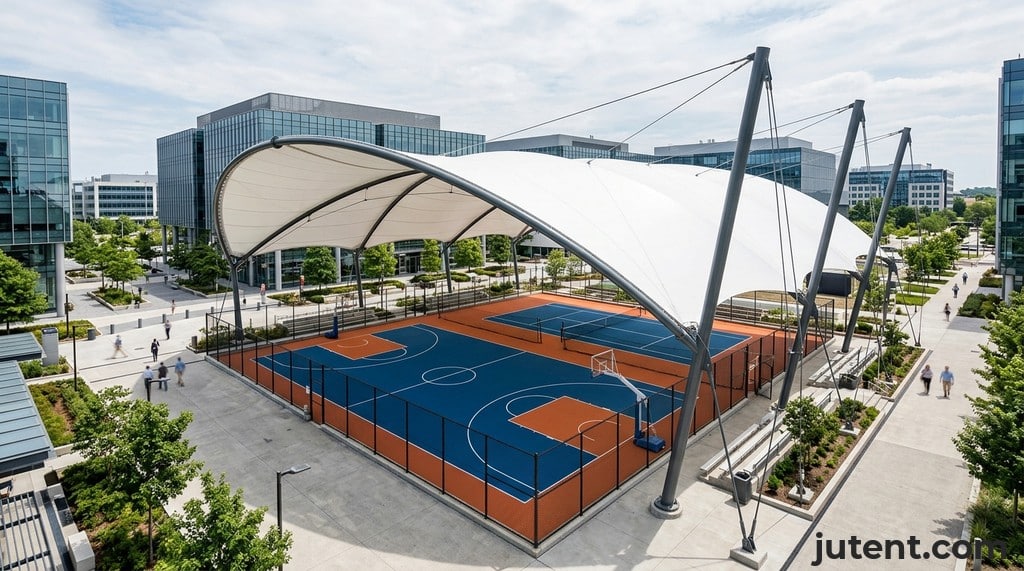
A sports court tensile canopy installation is a structured process, typically broken down into four critical phases. Each phase builds upon the previous one, requiring precise execution and adherence to engineering specifications. The initial phase involves preparing the ground and establishing a stable base for the structure. This is followed by the assembly and erection of the primary support framework. Once the steel structure is secure, the architectural membrane is carefully installed and tensioned to achieve its designed form and structural integrity. Finally, the project concludes with final adjustments and site cleanup. Based on Jutent's experience across 400+ projects in 30+ countries, meticulous planning for each phase is paramount for project success and long-term durability. Understanding these phases helps contractors allocate resources effectively and coordinate with the manufacturer. For more information on specific designs, visit our Sport Court Shade page.
Foundation Work: What Your Civil Team Needs to Complete Before Delivery
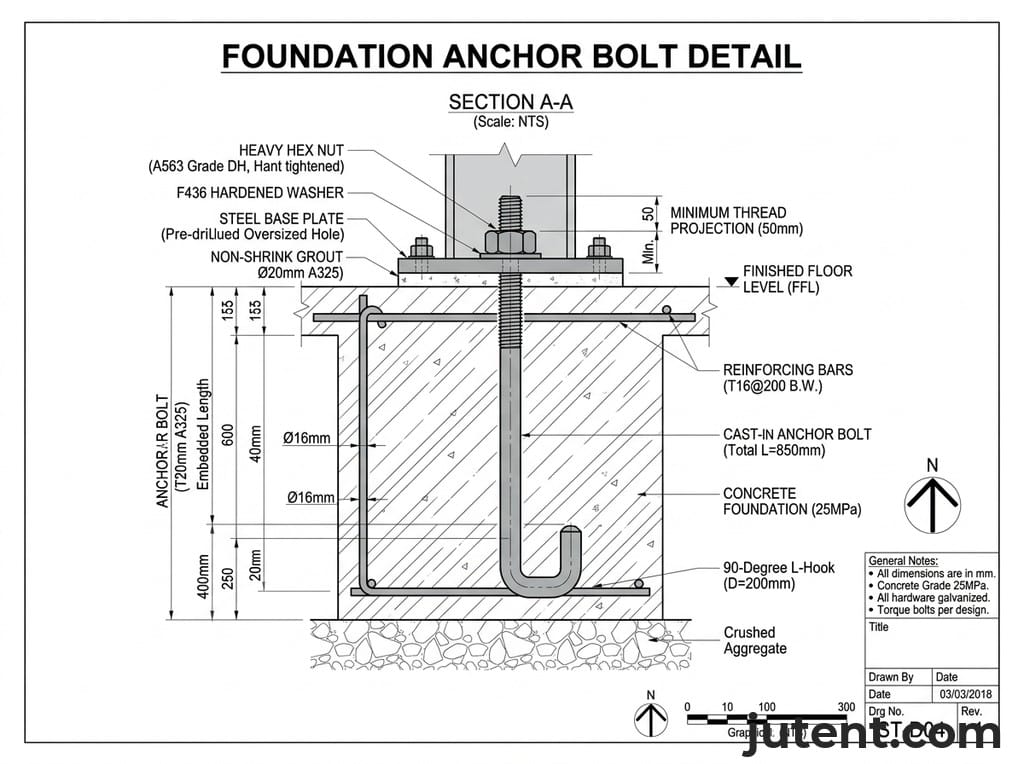
The success of any sports court tensile canopy installation hinges on reliable foundation work. This phase is entirely the responsibility of your civil engineering team and must be completed well in advance of the steel structure's arrival on site. Jutent provides thorough foundation drawings, including anchor bolt layouts, loads, and rebar schedules, which your team will use to construct the concrete footings. These drawings specify the exact dimensions, depth, and reinforcement required to withstand the design wind loads and membrane tension forces. Typical foundation types include isolated pad footings or strip footings, depending on the canopy's size and design. It is crucial that anchor bolts are cast precisely according to the provided templates, ensuring correct alignment and projection for the steel columns. Any deviation can lead to significant delays during steel erection. Proper curing time for concrete must also be observed before any structural loads are applied. This preparation is non-negotiable for the structural integrity of the entire tensile canopy. For a deeper dive into design considerations, refer to our Tensile Shade Structures Sports Courts Guide blog.
Steel Structure Erection: What Arrives Flat-Pack and How It Goes Together
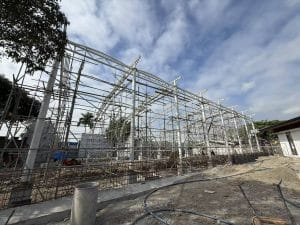
The steel structure for a sports court tensile canopy installation arrives at your site in a flat-pack format, optimized for efficient shipping and assembly. This typically includes columns, beams, trusses, connection plates, and various bracing elements. All steel components are fabricated from high-grade Q235B or Q355B steel, prepared with an epoxy zinc-rich primer and either an acrylic or fluorocarbon topcoat for corrosion resistance. Each component is pre-drilled and marked according according to the assembly drawings provided by Jutent. Your site team will be responsible for offloading, sorting, and assembling these components using cranes, lifting equipment, and standard construction tools. The erection sequence generally involves setting the main columns onto the pre-cast anchor bolts, followed by connecting horizontal beams and purlins. Connections are typically bolted, requiring precise alignment and torqueing to specified values. Safety protocols for working at height and lifting heavy loads are paramount during this phase. Detailed erection drawings and a bill of materials are supplied to guide your team through the entire assembly process.
Membrane Installation: Tensioning Sequence and Common Mistakes
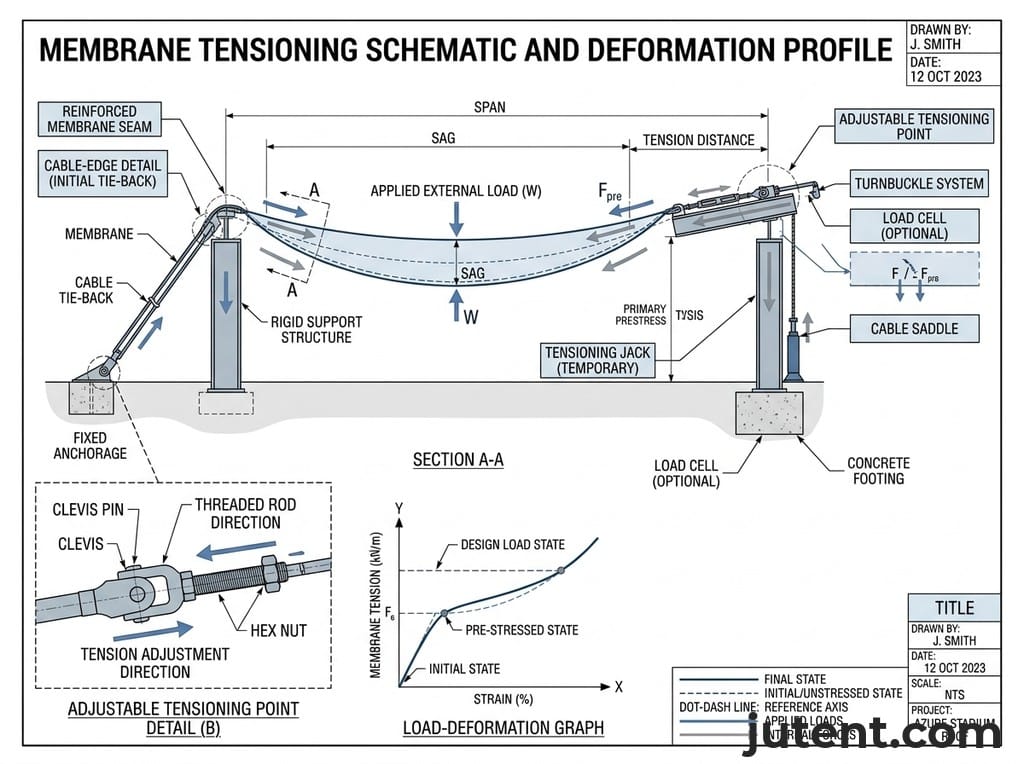
The membrane installation is a critical phase of the sports court tensile canopy installation, transforming the steel frame into a functional and aesthetically pleasing structure. Jutent typically supplies 1050 g/m² PVDF or PTFE membrane, pre-fabricated into panels with edge cables, corner plates, and attachment hardware. The membrane panels are carefully lifted into position, often using specialized lifting equipment to prevent damage. The installation sequence involves temporarily securing the membrane to the steel structure at various points, then systematically applying tension. This tensioning process is crucial for achieving the membrane's designed form, stability, and wrinkle-free surface. It typically involves adjusting turnbuckles or hydraulic jacks at specific anchor points, following a precise sequence outlined in Jutent's installation manual. Common mistakes include uneven tensioning, which can lead to wrinkles, stress concentrations, or improper water runoff. Incorrect handling can also cause tears or punctures. It is vital to protect the membrane from sharp objects and abrasive surfaces throughout the installation. The final tensioning ensures the membrane performs as designed, providing optimal shade and weather protection.
What Jutent Provides: Drawings, Instructions, and Remote Technical Support
Jutent Engineering acts as your manufacturing partner, providing a thorough support package for your sports court tensile canopy installation. Our deliverables include detailed design drawings, structural calculations, and material specifications, all compliant with ISO 9001 and SGS certifications. For export projects, Jutent can provide design drawings, calculations, material specifications, installation manuals, and free remote guidance, subject to project scope and contract terms. You will receive a complete set of fabrication drawings for the steel structure, precise foundation drawings with anchor bolt layouts, and a step-by-step installation manual for both steel erection and membrane tensioning. These documents are designed to be clear and actionable for your site team. Jutent offers free remote technical support via WhatsApp or video call throughout the installation process. Our experienced engineers are available to answer questions, troubleshoot issues, and provide guidance on specific steps, ensuring your team has the necessary expertise at their fingertips. This remote assistance is a key component of our commitment to successful project delivery.
When On-Site Installation Supervision Is Available
While Jutent provides extensive remote support, there are instances where on-site installation supervision for a sports court tensile canopy installation can be invaluable. For larger projects, typically those exceeding 500m² or involving complex designs, and primarily within Southeast Asia, Jutent can arrange for a qualified supervisor to be present on your site. This is a paid service, and its availability depends on project location, scope, and scheduling. An on-site supervisor brings direct expertise, ensuring that the installation adheres strictly to Jutent's engineering specifications and best practices. They can provide hands-on guidance for steel erection, membrane handling, and the critical tensioning sequence, helping to prevent common mistakes and expedite the process. For smaller projects or those in more remote international locations, our detailed installation guides and free remote technical support are designed to empower your local team. We recommend discussing the need for on-site supervision early in the procurement process to determine the most suitable support level for your specific project.
FAQ
- Q: Does Jutent provide on-site installation supervision for sports court canopies?
- A: For large orders (typically 500m²+) in Southeast Asia, Jutent can provide on-site supervision as a paid service. This ensures adherence to engineering specifications and best practices. For smaller projects or remote locations, we provide detailed installation drawings, video guides, and free remote technical support via WhatsApp or video call, empowering your local team to complete the installation successfully.
- Q: How long does it take to install a sports court tensile canopy?
- A: The installation time for a single court canopy (approximately 600m²) typically takes 5–10 days for an experienced crew of 4–6 personnel. This timeframe specifically covers the steel erection and membrane installation phases. Foundation work is a separate civil engineering task and should be completed 2–3 weeks before the structure's delivery to allow for concrete curing and site preparation.
Request our installation guide package — includes foundation drawings, erection sequence, and membrane tensioning instructions.